

Before paying for link building, find out whether you are buying research and outreach work, a paid advertising placement, or links intended to manipulate Google rankings. Those are different arrangements, even when the proposal calls all three “authority building”.
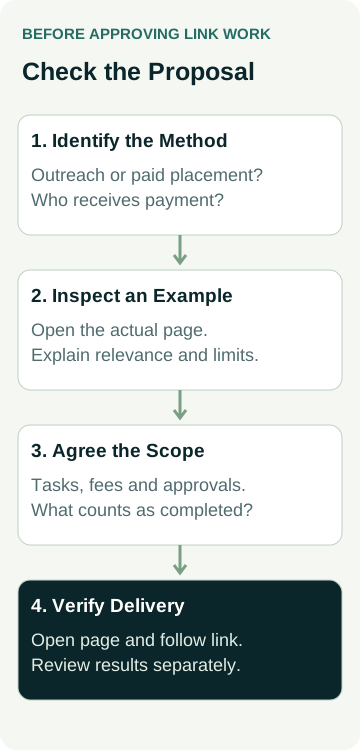
Do not approve a package just because it promises a number of links or a high authority score. Ask where the links would appear, whether the publisher is being paid, what your business is paying the agency to do, and how completed work will be checked.
For an Australian small business, the useful decision is whether the proposed activity has a clear purpose, acceptable methods and evidence you can review. A link count alone cannot answer that.
Ask the provider to separate agency work, publisher payments and promised outcomes. Keep anything unresolved out of the approved scope until you understand it.
Separate Outreach Work From Paid Placements
Paying someone to research relevant publications, prepare useful material and contact editors is different from paying a publisher for a link that passes ranking credit. An agency fee does not, by itself, tell you which arrangement is being proposed.
Google's link-spam policy includes buying or selling links for ranking purposes, automated link creation and certain link exchanges. It also recognises paid advertising and sponsorship links when they are appropriately qualified.
“Manual outreach”, “guest post” and “niche edit” describe parts of a process. They do not establish that the arrangement follows Google's policies. A manually negotiated paid article can still contain a link bought for ranking purposes.
Use this comparison to clarify the actual arrangement:
| Proposed Arrangement | What You Are Paying For | What to Clarify Before Approval |
|---|---|---|
| Editorial outreach | Research, useful material and contact with relevant publishers; publication remains their decision. | Tasks, examples, editorial discretion, any publisher payments and how unsuccessful outreach is reported. |
| Advertising or sponsorship | An agreed opportunity to reach a publication's audience. | Placement, audience fit, duration, fees and how paid links are qualified. Assess the advertising purpose separately from SEO claims. |
| Purchased ranking links | Links sold primarily to influence search rankings. | Do not approve this as a compliant SEO method. Ask for a revised approach consistent with Google's policies. |
For paid placements, Google prefers rel="sponsored"; nofollow remains acceptable. These are attributes on the publisher's link, not wording in your proposal. Ask the provider to explain how they will verify them against Google's outbound-link guidance.
A relevant publication and good writing do not remove the need to qualify a paid link. Nor does qualification make the advertising worthwhile automatically. You still need a sensible reason to reach that audience.
Ask for a Sample You Can Actually Inspect
Request a recent example that shows the kind of work being proposed. Where client information cannot be shared, ask for a suitable public or anonymised example and an explanation of its limits. A confidentiality constraint is a reason to clarify the evidence available, rather than proof of wrongdoing.
Open the actual publication and page. Is it a recognisable publication with material useful to the people you want to reach? Does the article make sense without the backlink? Is the linked page relevant to what the reader is learning?
Ask which parts of the example are representative of your proposed scope. A past editorial mention does not prove a future paid placement will use the same method. A screenshot of a publisher logo does not show where your link would sit.
Authority scores such as DA or DR are third-party tool metrics. If the proposal uses them, ask which tool produced the score, when it was checked and how it informs selection alongside relevance, readership and editorial standards. Treat a score as one input to investigate, rather than a safety certificate or promise of leads.
Likewise, ask whether quoted traffic is measured by the publisher or estimated by a tool, what period it covers and whether it concerns the whole site or the proposed section. Estimated site traffic is not evidence that people will read your placement or contact your business.
You do not need to become a backlink analyst. You need the provider to explain why a placement or outreach target makes sense for your customers and the page it would reference.
Make the Delivery Promise Specific
Separate what the agency controls from what depends on another party. It can agree to complete research, prepare material and make outreach attempts. An independent editor may decline, change the wording or publish without a link.
If a proposal promises a fixed number of placements, ask how that promise is fulfilled. Does it depend on paid inventory, agency-controlled sites or an arrangement with publishers? What happens when the agreed criteria cannot be met? A number is a starting point for those questions, rather than enough information to approve the work.
Ask for the following in the written scope:
- The service or useful resource the work supports, and the proposed destination page.
- The research, writing and outreach tasks included in the fee.
- Any publisher, sponsorship or other external charges, and who approves them.
- What your business reviews before material is submitted or published.
- The evidence required to mark each deliverable complete, including the response to missing or changed placements.
Confirm whether content preparation is included and what permission your business has to reuse supplied material. Ask about any continuing payment needed to keep a placement live. Paying an agency does not give your business control over an independent publisher's website.
For the wider engagement, compare these tasks with the current SEO package scope. Avoid assuming that a link-building line item includes every website change, content task or external fee your campaign needs.
A Worked Example: Three Items Under One Fee
An example commercial cleaning business receives a proposal headed “monthly authority building”. It lists research, an industry article and five links, but does not identify which items involve publisher payments.
The owner asks the provider to split the scope. The revised explanation contains three different activities: preparing a useful cleaning-maintenance resource on the business's website, contacting relevant industry editors, and paying for an article in a facilities publication.
The resource and outreach can be assessed as agency work. The owner asks who checks the factual cleaning advice, which page the outreach will reference, and what evidence will show that research and contact attempts were completed. An editor declining the material would be recorded as an unsuccessful attempt, rather than reported as a live backlink.
The paid article requires a separate decision. The owner wants to understand the publication's audience, the proposed placement, the duration and the link qualification. If the publisher will mark the paid link appropriately, the owner can consider the placement for its advertising purpose. There is no assumption that buying the article buys a ranking improvement.
If the provider insists the paid article needs an unqualified link to deliver the promised ranking benefit, the owner asks for that activity to be removed or replaced. A good-looking article does not settle the underlying method question.
This example ends with a clarified purchasing decision. It does not claim that outreach earned a link, that an advertisement produced enquiries, or that either improved search rankings.
Check Delivery Before Judging Results
Agree on a record that separates proposed, contacted, accepted, published and verified work. An editor's positive reply is not the same as a public page containing the agreed link. A report should let you distinguish those stages without guessing.
For each claimed live placement, request the referring page URL, destination URL, visible link wording, whether payment was involved, the relevant link attributes and the date checked. Ask someone who understands the page markup to verify attributes; a screenshot alone cannot show them.
Use a simple review sequence:
- Open the referring page and check that the stated content is present.
- Follow the link and confirm that it reaches the intended page.
- Have the provider confirm the payment arrangement and link qualification with inspectable evidence.
- Record changes, missing items and anything still awaiting publication.
- Review performance separately, using an agreed period and the available evidence.
Publicly visible is not the same as indexed by Google, and indexed is not the same as producing a business result. A newly verified link also does not establish that it caused a later ranking change. Other website work, competitors and search changes may be involved.
The broader monthly SEO report can provide search and campaign context. For your purchasing decision, keep completed work, referral visits, suitable enquiries and accepted jobs separate. If there is not enough evidence to assess an effect, record that limit and agree on the next review.
Ask what happens if a placement disappears or changes. Agree on the provider's investigation, reporting and any replacement responsibility before paying, rather than assuming links remain unchanged forever.
Discuss the Method Alongside Your SEO Priorities
Before adding link-building work, ask why it is a priority for the service you want to grow. A proposal should connect the activity to a genuine business need and a useful destination page. It should also identify any website or content work needed first.
Australian Web Experts' SEO service gives you a starting point for discussing those priorities and the support you need. Bring your website, the service you want to grow and the proposal wording you do not understand.
Get in touch with Australian Web Experts to discuss a suitable SEO scope. Clarify the methods, responsibilities and review before committing to a package of links.