

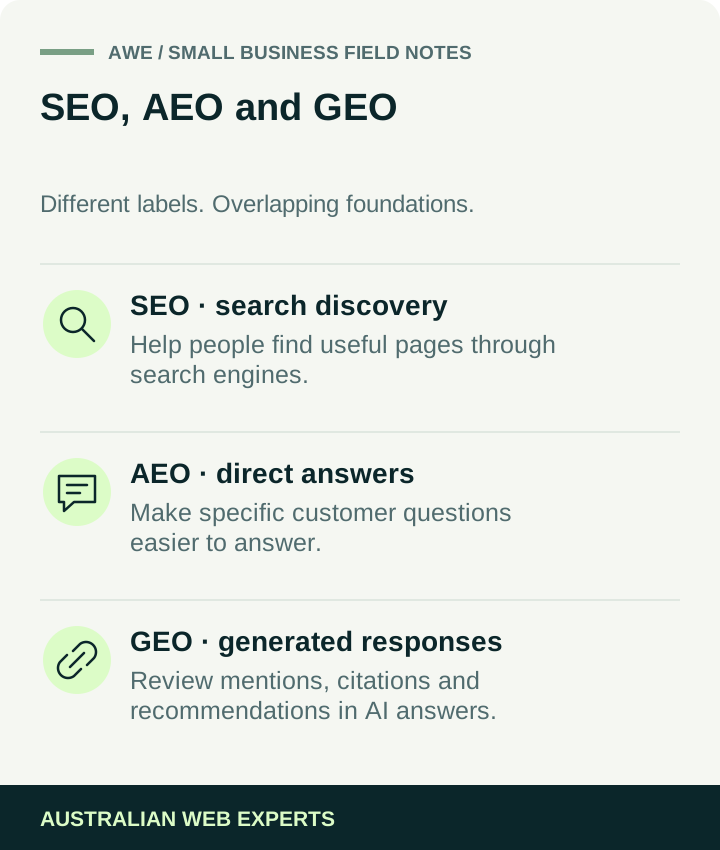
SEO, AEO and GEO describe overlapping work to help customers find and assess your business. SEO focuses on search visibility, AEO on direct answers, and GEO on visibility within generated answers. They share enough foundations that you should compare the actual work before buying three separate packages.
For a business owner, the decision starts with where you are losing potential customers. Your website may be difficult to discover, unclear about its services or receiving visits that never turn into enquiries. Each problem needs a different response.
SEO vs AEO vs GEO at a glance
The table below describes common usage. AEO and GEO do not have universally agreed boundaries, and providers sometimes use them interchangeably.
| Term | Common meaning | Example work | Useful evidence |
|---|---|---|---|
| SEO: search engine optimisation | Improving discovery through search engines | Technical fixes, service content, internal links and relevant promotion | Search queries, landing-page visits and enquiries |
| AEO: answer engine optimisation | Making content useful for direct-answer experiences | Answering specific customer questions with clear scope and evidence | Accurate answers and observed use of the content |
| GEO: generative engine optimisation | Improving visibility within AI-generated responses | Reviewing cited sources, business information and content gaps | Brand mentions, linked citations and recommendations |
None of those measures, on its own, establishes a return on investment. A monthly report should also show the work completed and whatever reliable customer-outcome data is available.
How AEO and GEO differ from traditional SEO
A standard search result often gives the user a link and a description. A generated answer can combine information from several sources before the user decides whether to visit a website. That changes what you may want to observe.
For example, a business could receive a citation for an informative guide without being recommended as a provider. It could be named in a response while the answer links to an independent directory. Looking only for a link to the homepage would miss some of those distinctions.
Our GEO explainer separates mentions, citations and recommendations. Our AEO guide shows how to improve an answer on a service page.
What work do they have in common?
All three give you reasons to review the information you publish. Does the page describe a real service accurately? Can a reader understand who it is for? Can the reader check important claims? Is the page connected to other relevant information on your website?
There can also be platform-specific access checks and reporting methods. Ask your provider to identify those explicitly. “We make your site AI-ready” is too vague to tell you whether anything useful will be delivered.
For Google's own AI search features, the company says its existing SEO practices remain relevant. Google's documentation does not describe a separate set of special optimisations required for AI Overviews or AI Mode.
Which should a new local business prioritise?
Imagine a fictional electrician with a new five-page website. The site doesn't explain service areas, several pages contain placeholder text and the contact form hasn't been tested.
We would start by fixing those problems. Record the services, publish accurate contact and coverage information, finish the pages and verify the enquiry path. Establish basic search reporting so later decisions have a starting point.
It is reasonable to consider AI search during that work. It would be difficult to justify a separate campaign of acronym-focused blog posts while the main service pages still fail to explain the business.
For this situation, use the local AI search checklist alongside the business's ordinary website and SEO work.
What if you already have useful Google traffic?
Consider an established accounting firm with useful guides and regular organic enquiries. A sensible next step is to check whether customers' AI questions lead to accurate information about its actual services.
Start with a fixed set of relevant questions. Record answers, linked sources and inaccuracies. If the same missing detail comes up repeatedly, decide whether to improve an existing service page, correct a public profile or create a genuinely useful guide.
Keep measuring the existing Google traffic and enquiries. There is no reason to discard a productive channel merely because a new label has become popular. Ask any provider recommending that change to show its reasoning against your business's data.
What about a national specialist business?
A national provider may need to answer more detailed suitability and comparison questions. A buyer could ask which type of provider fits a particular project, what changes the cost or how implementation works.
Here, a relevant project example, a detailed scope explanation or an honest comparison may help the reader assess the business. The owner or subject specialist needs to contribute the facts. Publishing general marketing prose about “tailored solutions” won't explain what makes the offer suitable.
Before adding new pages, check what already exists. Several weak pages answering the same question may be better replaced by one complete, maintained resource. Plan any URL changes carefully so existing useful links are preserved.
A decision table for your next step
| What you observe | Sensible first action | Evidence to ask for |
|---|---|---|
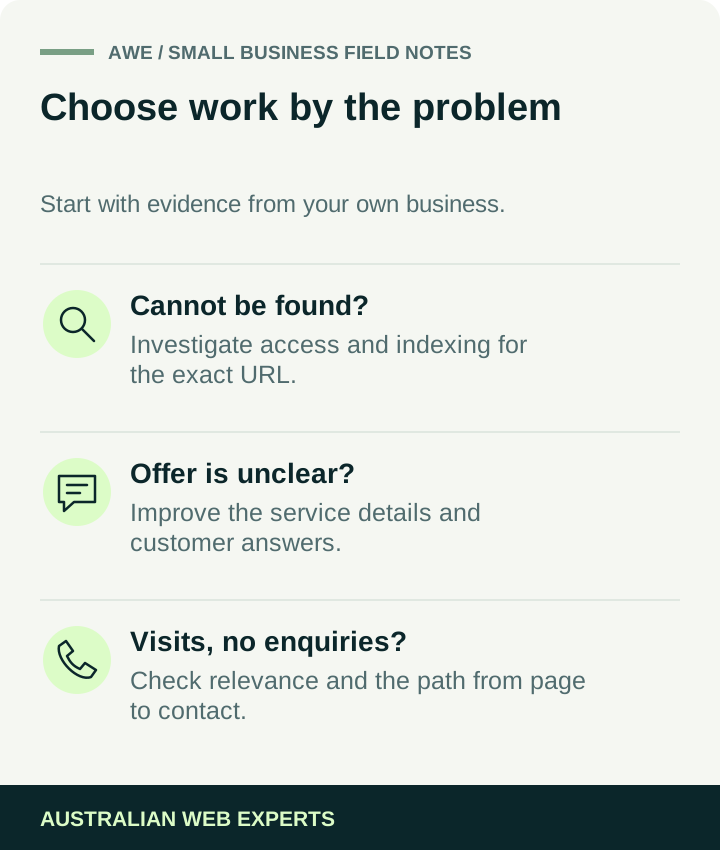
| Important pages cannot be found in search | Investigate access and indexing | Findings for the exact URLs, not a generic score |
| Visitors cannot tell what you offer | Improve the relevant service page | Correct facts, useful scope and a working enquiry path |
| AI answers describe your business incorrectly | Inspect the response and its cited sources | Saved examples, corrections made and follow-up checks |
| You appear in answers but see no enquiries | Examine relevance and the customer journey | Useful referral and enquiry data, with attribution limits |
| Your provider promises guaranteed AI recommendations | Ask how the guarantee can be verified | Defined questions, platforms, dates and exclusions |
These are diagnostic starting points. More than one issue can apply, and the evidence may point to a different next step after a proper review.
Do you need a separate AEO or GEO budget?
Sometimes there is additional work to pay for: researching questions, correcting information, producing original examples, checking access or adding a measurement process. Sometimes that work is already part of an existing SEO agreement.
Ask for the overlap to be made explicit. If your SEO package already includes content improvements, which additional pages or tasks does the GEO proposal cover? If reporting costs extra, what does it measure that the current report doesn't?
We would ask five questions before agreeing to a new service:
- What specific problem have you found on our website or in search answers?
- What will you change, and which parts need our input?
- What is already covered by our existing agreement?
- How will you distinguish completed work from results?
- What information will we receive if the results don't improve?
Choose the work your business needs
Use our AI search work plan to organise the first checks, and our reporting guide to define the measures before work begins.
If you'd like help reviewing your current position, talk to Australian Web Experts. Bring your website, the services you want more enquiries for and any existing reports. That gives us something concrete to assess before recommending a package.
Updated 1 October 2026. Prepared by Australian Web Experts with AI-assisted drafting, source checks and worked examples. Platform guidance checked 28 September 2026; interfaces and reporting may change. Fictional examples are labelled in the text.