

Answer engine optimisation, or AEO, is the practice of making your content useful for systems that provide direct answers to people's questions. For a business website, it starts with understanding what customers need to know and answering it clearly, with enough detail to be useful.
If a customer asks whether your electrician installs home EV chargers, a paragraph about your commitment to excellence won't answer the question. They need to know whether you offer the service, where you work and what you need to assess before quoting.
That is a good starting point for AEO: take a real customer question and make the answer easy to find, understand and check.
What does AEO stand for?
AEO stands for answer engine optimisation, also written “answer engine optimization”. It is a marketing term used for work aimed at direct-answer experiences, including AI-generated responses.
The term overlaps with generative engine optimisation. Some providers use AEO broadly, including featured snippets and voice answers; others use it mainly for AI products. These experiences do not all work identically, so a provider should identify which ones it is targeting.
For a practical comparison of the labels, read SEO vs AEO vs GEO. The useful part of any proposal is the work it describes and how it will be assessed.
Start with questions your customers already ask
You don't need to invent a list of hundreds of questions. Start with the conversations you already have before a booking or sale.
For a service business, useful questions often concern suitability, coverage, price variables, timing, preparation and what happens when something goes wrong. Ask the person who answers the phone which questions come up repeatedly. Review enquiries without publishing customers' personal information.
An electrician might hear, “Can you install the charger I've already bought?” A bookkeeper might hear, “Can you take over partway through the financial year?” A builder might hear, “Can we live in the house during the renovation?”
Each question needs a different answer. A short factual answer may belong on a service page. A decision with several conditions may deserve its own guide. Group related questions so a reader can finish a task without opening six nearly identical pages.
An example of a more useful answer
The following copy is a fictional demonstration. It does not describe a real electrician's offer or a measured ranking improvement.
Before
“We offer premium EV charging solutions tailored to your needs. Our experienced team delivers excellent service. Contact us today.”
After
“We install home EV chargers in Geelong and the Bellarine. Before quoting, we check your charger model, parking location, cable route and switchboard. Send us the charger details and a photo of your switchboard, or contact us to arrange an assessment. We confirm the installation scope and any additional electrical work in your quote.”
The second version gives the reader something to act on. It states the service and coverage, explains why an assessment is needed and tells them what to send. It doesn't invent a price, promise that every installation is straightforward or hide the possibility of additional work.
For a real business, each detail must be checked. Don't publish the sample verbatim if those aren't your services, service areas or quoting requirements.
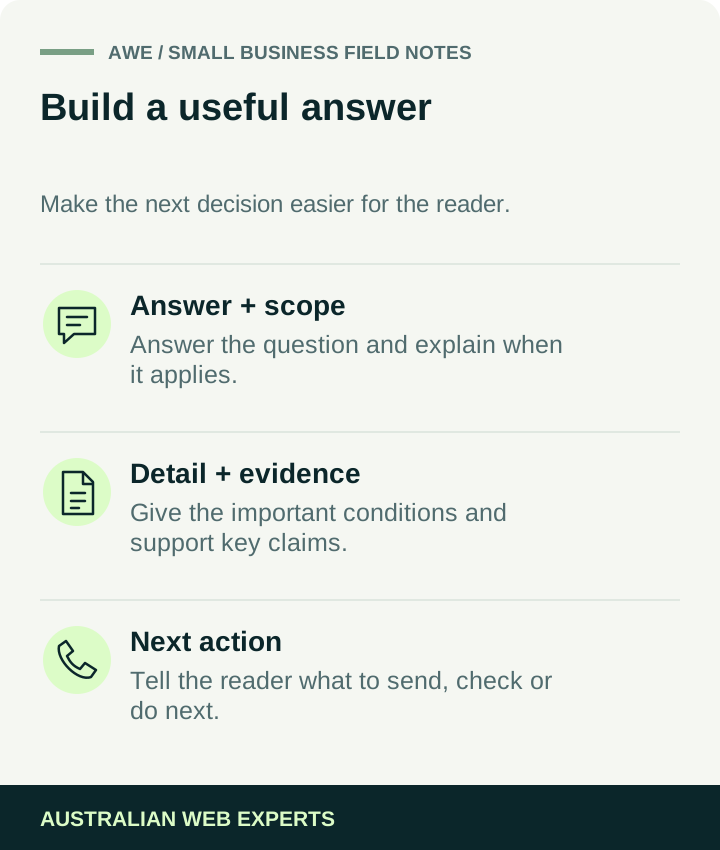
A repeatable way to write an answer
Use this editing sequence when reviewing a page. It is an editorial tool, not a platform ranking formula.
| Check | Ask yourself | A useful improvement |
|---|---|---|
| Answer | Have we answered the actual question? | State the service, decision or condition directly |
| Scope | When does the answer apply? | Name the relevant customer, location or situation |
| Detail | What would the customer ask next? | Explain the important variables or steps |
| Evidence | Can a reader check our claim? | Link to a relevant project, credential or primary source |
| Action | What should the reader do now? | Explain the information needed for the next step |
Read the result aloud. If it sounds like a brochure that could belong to any company, identify what is still missing. The goal is to explain your business accurately enough that a stranger can make a decision.
Where should the answers go?
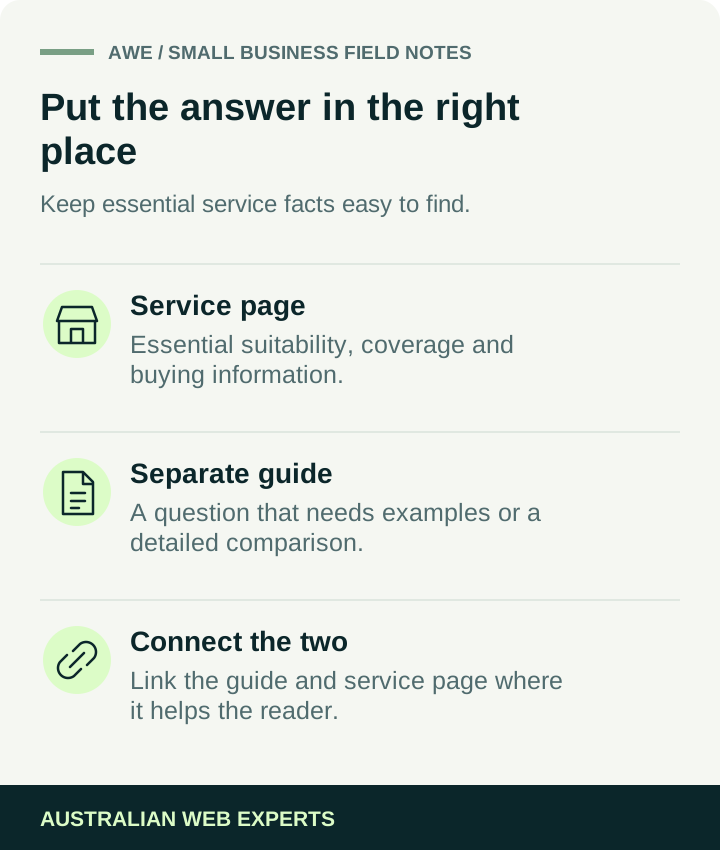
Put essential buying information on the relevant service page. A visitor shouldn't have to search your blog to learn whether you provide the service in their area.
Use a separate guide when a question needs an explanation, examples or a comparison. For instance, an article about preparing for a renovation can link to the renovation service page. The service page can link back to the guide for readers who need more detail.
FAQs are useful for remaining questions that don't fit naturally elsewhere. Avoid placing all meaningful information in a long accordion while the visible page says very little. Check the page on a phone and make sure the reader can follow the order of information.
Google's SEO Starter Guide supports readable, well-organised content and descriptive links. It also explains that its language systems can understand variations in wording. You don't need to repeat an exact keyword in every answer.
What about schema and special AI files?
Structured data is a way of describing information on a page in a machine-readable format. Use it accurately where appropriate, with technical help if needed. An agency should explain what it is adding and why.
For Google AI Overviews and AI Mode specifically, Google says no special AI markup or new AI text files are required. That statement has a defined scope; it is not documentation for every other AI platform. See Google's AI feature guidance.
A proposal that consists entirely of adding a file or installing a plugin deserves questions about what else the customer needs and how success will be measured.
How long should an answer be?
Long enough to answer the question accurately. A service-area answer may take a sentence. A pricing question may need several variables and an example. A technical question may need diagrams or steps.
Avoid cutting an answer to a fixed number of words when that removes a necessary condition. Likewise, don't pad a straightforward answer with repeated definitions. Google's content quality guidance explicitly rejects the idea that it has a preferred word count.
How do you measure AEO?
Record which question was tested, the platform, the response and any linked source. Check whether the answer is accurate, whether your business appears and whether the referenced page is the one you expected.
Then keep those observations separate from visits and enquiries. You can improve the clarity of a page without immediately observing a new citation. Equally, one citation doesn't establish that the entire website is performing better.
Our AI visibility worksheet gives you a consistent way to record checks. For Google-specific steps, use the AI Overviews guide. For the wider work plan, start with AI search optimisation for Australian businesses.
If you'd like us to review which customer questions your site leaves unanswered, get in touch and tell us which service page you want to improve.
If you want help improving those answers, see what our AI SEO work covers, from service-page priorities to dated visibility checks.
Updated 1 October 2026. Prepared by Australian Web Experts with AI-assisted drafting, source checks and worked examples. Platform guidance checked 28 September 2026; interfaces and reporting may change. Fictional examples are labelled in the text.