
A Google Business Profile and a ChatGPT business profile are separate records with different eligibility and management routes. Check each platform against the way your business actually serves customers. Having one profile does not establish that you can claim the other.
For an Australian business, the important distinction is between serving customers at a physical location, travelling to them and selling or delivering a service online. A mobile plumber, an online consultancy and a shop with an ecommerce store should not all receive the same setup advice.
Start with the customer’s task and the information they need. Then decide which record you can legitimately manage today, which public details need correcting and what remains outside your control.
Compare the Available Routes Before Starting a Claim
Google’s representation guidelines describe Business Profiles for businesses with a customer-facing physical location or those that travel to customers. The business still needs to meet the applicable rules and accurately represent its location and services. Google’s eligibility guidance excludes online-only businesses.
OpenAI’s current setup guidance makes eligibility depend on business type, location and supported verification. Eligible online businesses may have a claim or add route. Its local-store and restaurant route currently covers existing US listings. An Australian address or a working website does not remove those conditions.
Use this comparison to frame the next question, rather than as an approval for any particular business:
| Business Situation | Google Business Profile Question | ChatGPT Business Profile Question |
|---|---|---|
| A mobile trade visiting customers | Does the business meet the service-area rules for its actual operation? | Which route is offered for the real service model? Do not assume Google eligibility carries across. |
| An Australian shop customers visit | Does the location meet Google’s customer-facing business requirements? | The current local-store route has a US listing limitation; check it before attempting a claim. |
| A business delivering its service online | A purely online-only business is not eligible under Google’s rules. | Check the eligible online-business route and the verification offered for that business. |
| A retailer selling online and from a shop | Identify the Google location and service details being represented. | Distinguish the online business, physical location and any separately available product features. |
If you want assistance deciding which route fits, check your business’s eligibility for guided setup. Describe how customers buy and receive the service. AWE can discuss the available profile and website work without assuming a claim will be approved.
Can a Mobile Tradie Without a Shopfront Get Listed on ChatGPT?
A shopfront is not the only way a business can operate, but Google’s service-area category is not a ChatGPT eligibility category. Describe the actual business instead of choosing a convenient label.
For Google, the service-area guidance addresses businesses such as plumbers and cleaners that visit customers. It says to remove the address from the profile if customers are not served there. Do not invent an office or advertise a home address as a shopfront to fit a profile.
For ChatGPT, check the options available to the business under OpenAI’s current rules. A trade that attends customers’ homes should not present itself as an online-delivered service merely because enquiries arrive through a website. If the route is unclear or unavailable, keep the facts accurate and seek clarification rather than creating a duplicate or false location.
Also separate being mentioned from claiming a record. ChatGPT may discuss a business without the owner managing a profile. That observation does not establish that a claim is available, verified or influencing recommendations.
Does ChatGPT Use Google Maps for Business Listings?
Do not treat a Google Maps result as evidence that a particular ChatGPT answer used it. Inspect the answer you actually saw: its business identity, location, links and any sources it displays.
OpenAI’s businesses-in-ChatGPT information explains that claiming supplies business information while recommendations remain independent. The material reviewed here does not establish a universal Google Maps import or synchronisation arrangement for every ChatGPT listing or answer.
If an answer shows a source, record that specific source. If it does not, label the source unknown. A matching phone number or description on two platforms is insufficient to identify how one obtained the information.
This keeps the correction work practical. You can verify and update information you control without making an unsupported claim about the data behind every generated answer.
Does Updating Google Opening Hours Update ChatGPT?
An edit in your Google profile should be checked on Google. It is not evidence that ChatGPT’s profile or a generated answer has changed. Check the ChatGPT result separately before telling the team that both are current.
Keep a small record of the business name, location, hours, page or answer inspected and the time of observation. Note whether you checked a managed profile, an independent answer or an underlying website. These are different observations.
If a ChatGPT answer still shows old hours, inspect any source it provides and check the matching website and other records under your control. Where you can manage a ChatGPT profile, review the information supplied there too. Record an edit as submitted or saved until you have checked the relevant public result.
Our guide to how ChatGPT finds business information covers the wider discovery question. Changing a record is useful maintenance; it does not supply a deadline for an independent answer to update.
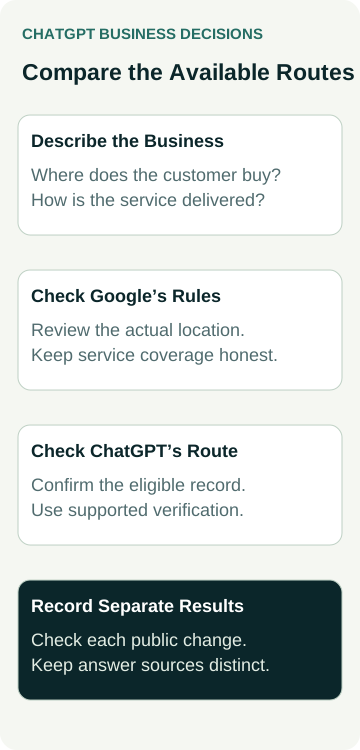
A Worked Example: A Mobile Plumber and an Online Consultancy
An example mobile plumbing business visits customers and has no premises open to the public. The owner wants accurate hours and a clear explanation of the jobs the team accepts.
The Google review starts with the service-area arrangement and genuine coverage. The ChatGPT enquiry starts with the actual delivery model and available claim route. The owner does not create a pretend shopfront or describe on-site plumbing work as an online service to bypass a restriction.
An example consultancy delivers its service online. Its owner checks the eligible online-business route in Business Hub, identifies the matching record and reviews the verification offered. If the consultancy is purely online, Google’s online-only exclusion applies. The different ChatGPT route does not change that.
Neither example reports an actual claim, approval or recommendation result. The useful decision is which supported action the owner can take, with which facts and account, before commissioning work.
For a retailer combining an online store and a physical shop, there is another distinction. A product appearing in shopping results is not the same as managing a business profile. If the store uses Shopify, separate product discovery, the profile and the Business Agent before planning the work.
Keep Control and Check the Result on Each Platform
Use business-controlled accounts and the access arrangements each platform supports. Agree who approves the public facts, who completes requested verification and who records the outcome. A quote for assistance should identify the particular profile and website work rather than promise a position in an answer.
For the claim sequence itself, use our Australian ChatGPT profile claiming guide. This comparison helps choose the right question; the claiming guide owns the steps and eligibility branches.
Keep the Google edit, the ChatGPT profile and the observed ChatGPT answer as separate entries. Mark each result only when you have checked that result.
Before starting, confirm the business’s real service model, the record you intend to manage and the current route offered. If a platform cannot support the proposed action, record that limitation and focus on accurate website and customer information while you clarify the next step.