

AI search optimisation is the work of making your business easier to find, understand and reference in AI-generated answers. For a small business, that means giving tools such as ChatGPT and Google's AI search features clear, accurate information about what you do, who you help and why a customer might choose you.
You still need a useful website. You still need to explain your services. And you still need a way to turn a visitor into an enquiry. Another acronym doesn't change those jobs.
If you're wondering where to start, we'd begin with one service you want more enquiries for. Work through the checks below on that service before paying to rewrite your entire website.
What does AI search optimisation involve?
Consider a fictional plumbing business in Geelong. Its homepage says it offers “quality plumbing solutions”, but doesn't explain whether it replaces hot water systems, works on weekends or services the customer's suburb.
Now consider the customer's question: “Who can replace an electric hot water system in Geelong, and what should I ask before booking?”
The business may be perfectly capable of doing the job. Its public information gives a prospective customer very little to work with, though. Our starting point would be a useful hot water service page: the systems it works on, actual coverage, how quoting works, relevant qualifications and a clear contact option.
That is a sensible improvement whether the person arrives through Google, an AI answer or a recommendation from a neighbour. Any resulting AI visibility still needs to be observed and measured.
SEO, AEO and GEO explained without the sales pitch
SEO, or search engine optimisation, helps people discover your website through search engines. Our guide to SEO explains the basics.
AEO, or answer engine optimisation, usually describes work intended to help content answer questions directly. GEO, or generative engine optimisation, focuses on visibility within generated answers, including mentions and citations.
The terminology overlaps. Different providers draw the boundaries differently, so ask what work a proposed package includes. Our SEO vs AEO vs GEO comparison helps you compare the deliverables.
“AI SEO” can also mean using AI tools to help with ordinary SEO tasks. A tool that helps write a page and a campaign to improve visibility in AI answers are different things. Make sure you and your provider mean the same thing before discussing a budget.
You may also encounter LLMO, meaning large language model optimisation, or AIO, which is used for several AI-related activities. The label is less useful than a clear explanation of the problem, the work and the evidence used to judge it.
Start with the page that matters to your customer
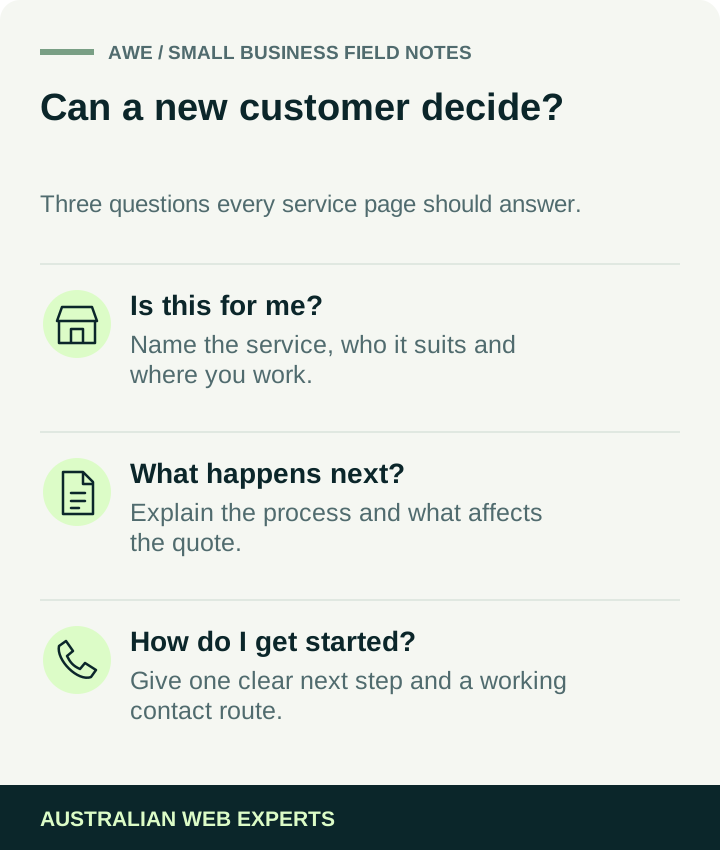
Pick a service that is commercially useful to your business. Read its page on your phone and try to answer these questions without relying on what you already know:
- What exactly can this business do for me?
- Does it work in my area or with businesses like mine?
- What happens after I enquire?
- What information does it need to give me a quote?
- What evidence supports its claims?
- Can I contact someone easily?
If the answers are missing, fix that first. Record that task and any retest with our mobile enquiry-path worksheet. Publishing a glossary of marketing acronyms won't help the plumber's customer understand whether the plumber can replace their hot water system.
For a national consultancy, the details will be different. Its reader may need to understand industry experience, project scope, working arrangements and who will do the work. The principle is the same: identify the customer's decision and provide the information needed to make it.
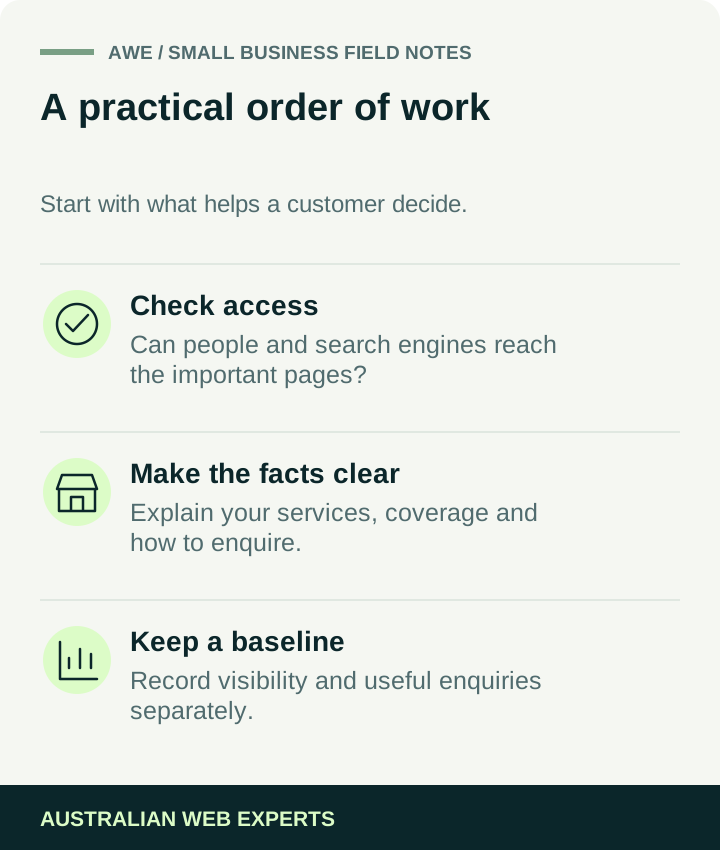
A practical order of work
This is the checklist we'd use to organise an initial review. It is a work sequence, not a formula that guarantees a ranking.
| Priority | What to check | Who usually handles it | What counts as done |
|---|---|---|---|
| 1 | Important pages can be opened and discovered | Website or SEO specialist | Access and indexing checks recorded for the actual URLs |
| 2 | Services, contact details and coverage are accurate | Business owner | Facts checked against current operations |
| 3 | Service pages answer buying questions | Owner and writer | A new reader can understand suitability and next steps |
| 4 | Claims have supporting evidence | Owner and writer | Relevant examples, credentials or sources are visible |
| 5 | Important public profiles agree | Owner or marketing team | Incorrect business details corrected on relevant profiles |
| 6 | Enquiries and visibility have a baseline | Marketing team | A dated report with clearly defined measures |
Download the editable AI search action checklist and add a responsible person and review date to each task.
For the Google side, its SEO Starter Guide recommends useful content, clear organisation and links that help readers discover related pages. Those foundations are a good place to spend effort before chasing an unfamiliar add-on.
Add evidence a customer can check
Replace broad claims with details that help someone assess your business. A completed-project page can explain the original problem, the work performed and the result, with permission to show the details. A pricing explanation can identify what changes a quote. A process page can explain how the business handles a booking.
You don't need to publish confidential customer information. A carefully anonymised example can still be useful if it is accurate and doesn't pretend to be more specific than it is. If you use a fictional example to teach a concept, label it clearly.
Avoid adding a statistic because you think every paragraph needs one. A precise explanation of how your service works may be far more useful than a loosely related industry percentage. Google's helpful-content guidance asks publishers to contribute original value and make authorship and expertise clear.
A sensible first month
In the first week, record the starting position. Choose a small set of customer questions, identify the pages intended to answer them and check current enquiries from organic search where reporting is available.
In week two, correct the most important access and accuracy problems. In week three, improve one or two priority pages with the business owner's input. In week four, verify that the changes are live, links work and the enquiry process works. Repeat the original visibility checks and record what changed.
This is an example delivery schedule. It is not a promise that search engines will index the pages or recommend the business within a month. It does give you something concrete to inspect when you receive an invoice.
Choose the next guide for your situation
If customers are asking ChatGPT for providers, follow our ChatGPT business visibility guide. For Google's generated answers, use the AI Overviews guide.
If you serve a defined area, the local-business checklist focuses on the information your customers need. To judge results, use our AI search reporting guide and worksheet.
What should you pay someone to do?
Ask for a proposal tied to your starting position. It should identify the pages being worked on, the changes planned, who supplies business information and how completion will be checked. Ongoing work should explain what will be reviewed after the initial fixes.
Separate the delivery of work from its outcome. A rewritten service page is a deliverable. A new citation is an observation. A qualified enquiry is a business result. A useful report shows the relationship without pretending every change caused every enquiry.
See how our SEO services are planned around your business, from the first priorities to ongoing reporting.
For help applying these steps to your own website, our AI SEO service sets out the review, implementation and reporting work we can agree with you.
If you'd like help deciding which part of your website needs attention first, talk to Australian Web Experts. Tell us what service you want more enquiries for and where your customers are based.
Updated 1 October 2026. Prepared by Australian Web Experts with AI-assisted drafting, source checks and worked examples. Platform guidance checked 28 September 2026; interfaces and reporting may change. Fictional examples are labelled in the text.