

To improve your business's chances of appearing in ChatGPT search, start with accurate public information, useful pages about your services and access for its search crawler. Then test relevant customer questions and record what the answers actually say.
There is no dependable way to make an organic recommendation happen simply by adding a phrase to your homepage. Your job is to make the business understandable and worth considering, then check whether the information is being used accurately.
This guide covers organic visibility in ChatGPT search. Advertising, shopping integrations and custom applications have different requirements and should be assessed separately.
First, define what “on ChatGPT” means
A response to “Tell me about Example Electrical” is a branded lookup. The user has already supplied the business name. It can help you check accuracy, but it doesn't show that an unfamiliar customer would discover you.
A question such as “What should I ask an electrician before installing an EV charger at home in Geelong?” has a different purpose. A third question, “Which electricians service my area and install this type of charger?”, asks for providers.
Track these separately. A helpful answer to a general question, a brand mention, a linked citation and a provider recommendation each tell you something different. Our GEO guide explains those distinctions with an example.
Establish a baseline before changing the website
Choose a small, fixed set of questions that reflect the services you want more enquiries for. Include questions about suitability, comparison and the next step before contacting a provider.
For a fictional home-services company, the starting set could look like this:
| Question type | Example | What to inspect |
|---|---|---|
| Branded accuracy | “What services does Example Electrical offer?” | Correct services, location and contact information |
| Customer research | “What should I check before booking a home EV charger installation?” | Useful advice and the sources linked |
| Local suitability | “How do I find an EV charger installer serving Geelong?” | Whether the suggested providers fit the location and job |
| Comparison | “What should I compare in two EV charger installation quotes?” | Whether linked pages help the customer make that decision |
These are demonstration questions, not evidence about a real business. Adapt them to the language your customers use. Avoid making every question a request to praise or recommend your company.
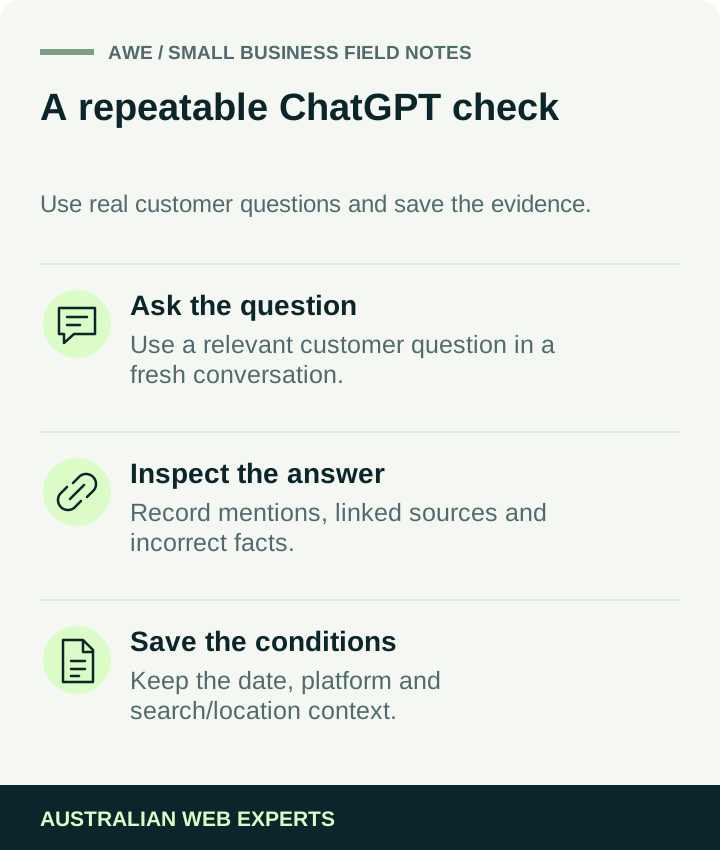
Record the date, platform, exact question, location context and whether web search was used. Save the response and its linked URLs. Use a fresh conversation for a baseline check so earlier messages naming your business don't quietly influence the result.
Don't enter customer identities, private quotes or confidential project details. You can test a general service question without sharing personal information.
Check access for ChatGPT's search crawler
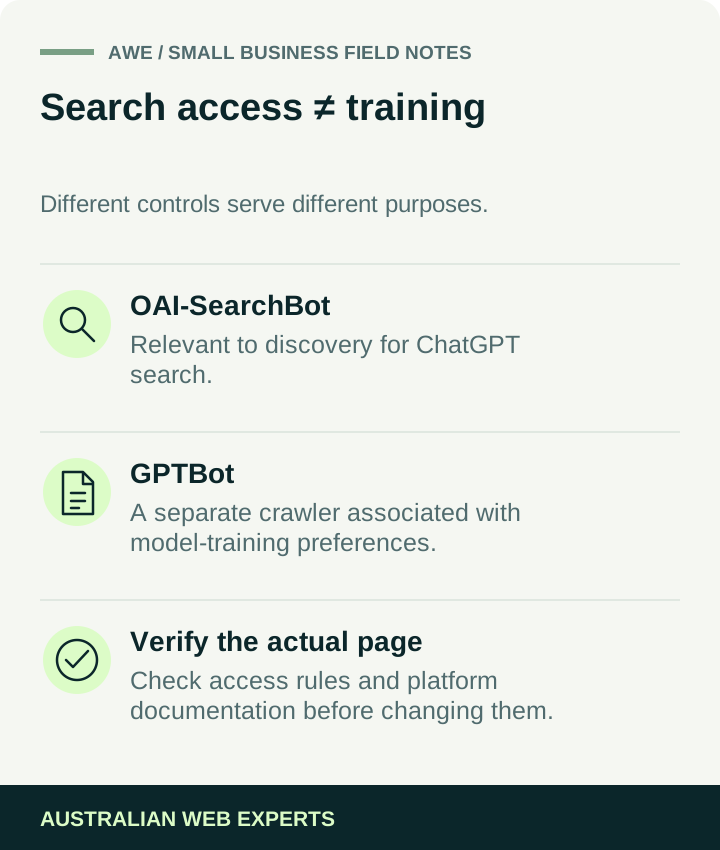
OpenAI's crawler documentation distinguishes OAI-SearchBot, used for search, from GPTBot, used for potential model-training material. The controls are independent. Allowing training is not a requirement for allowing search access.
Ask your website specialist to check the site's robots.txt rules and whether the hosting or security layer allows legitimate OAI-SearchBot requests. OpenAI publishes IP information alongside the documentation. A page opening in your browser doesn't prove a crawler can access it.
Do not remove security protections or allow every automated request as a shortcut. The task is to identify and resolve an actual restriction affecting the relevant search crawler. Preserve intentional restrictions on private pages.
A useful technical handover records the URL checked, the rule or response found, the change made and the result of the follow-up check. “We unblocked AI” is not a sufficient description of the work.
Make each important service understandable
Read the page a customer would land on. If it says little more than “experienced team” and “quality service”, identify the facts a prospective customer still needs.
Explain the actual service, who it is suitable for, your genuine coverage and the process for assessing a job. Address the questions that regularly arise before an enquiry. Include relevant examples or credentials that you can substantiate.
For a commercial service, buyers may need to understand minimum project scope, delivery arrangements or what is included in a proposal. For a local service, location and availability may be more important. Don't force every business into the same template.
The before-and-after example in our AEO guide shows how to replace vague copy with useful detail. Our local-business checklist covers service areas and public profiles.
Inspect the sources, not only the final answer
When ChatGPT provides links, open the relevant sources and check what they establish. Does a page describe your current offer? Is the business name correct? Is an old directory profile supplying an outdated address?
If the answer is wrong, don't immediately rewrite every page on your site. Save the example and work through the likely source of the error. Correct a fact you control, or request a correction from the site responsible for it.
Sometimes the response won't provide enough evidence to explain the error. Record that uncertainty. You can improve your public information without claiming to know exactly why a particular answer was generated.
Use independent evidence where it belongs
Genuine reviews, relevant industry listings and accurate business profiles can help a prospective customer assess you. A documented project can explain experience that a generic service claim doesn't demonstrate.
Choose sources because they matter to your audience. Don't buy irrelevant mentions or fabricate customer endorsements to manufacture the appearance of authority. Ask an agency proposing outreach which audiences it intends to reach and what would make the placement useful.
If a profile is no longer accurate, maintaining it may be more useful than creating another one. Keep a record of where business details are published so the next address, service or contact change can be handled consistently.
Repeat the checks and keep the conditions visible
Repeat the same questions after the changes are live, using comparable settings. Answers can vary. A useful comparison needs several observations rather than whichever screenshot looks best.
Our downloadable AI visibility worksheet includes fields for the test conditions, mentions, recommendations, cited URLs and accuracy notes. The reporting guide explains how to calculate a sample rate without turning it into a claim about the whole market.
Check referral visits and enquiries separately. Where your analytics records visits from ChatGPT, inspect the landing pages and whether those visits lead to useful actions. Missing referral information is not proof that nobody used ChatGPT before contacting you, and an AI mention is not proof of a sale.
What should you expect from a provider?
Expect a defined scope: the questions being monitored, the pages being improved, the technical checks and the reporting method. Ask to see unfavourable and incorrect responses as well as favourable ones.
Be cautious about organic recommendation guarantees without a precise, verifiable definition. The provider should be able to explain what it controls and what remains a platform decision.
If you'd like help assessing your website's public information and search visibility, contact Australian Web Experts. Include your website and the service you want more customers to find. For the wider work sequence, use our AI search optimisation guide.
Updated 1 October 2026. Prepared by Australian Web Experts with AI-assisted drafting, source checks and worked examples. Platform guidance checked 28 September 2026; interfaces and reporting may change. Fictional examples are labelled in the text.