

Before paying to reduce website form spam, ask the provider to trace where the unwanted messages arrive and explain how genuine enquiries will be checked. A quieter inbox can be useful. It does not establish that the form still accepts the customers you want to hear from.
For an Australian service business, the job is to reduce unwanted submissions while keeping a usable route for people requesting suitable work. The proposal should explain the current problem, the changes being considered, what customers may experience and who handles an unexpected block.
Start with a few redacted examples and the affected website address. Ask for an assessment of the actual form and its delivery path before approving another plugin, a visible puzzle or a change to the whole website.
Trace Where the Unwanted Messages Arrive
Ask the website provider to distinguish a form submission from a message sent directly to a published email address. A change to the form cannot be assumed to address both. The investigation should identify the route using appropriate records, rather than infer it from the message's appearance alone.
Keep the observation specific. Record the affected page, approximate time and where staff saw the message. Redact names, contact details and message content that the reviewer does not need. Keep passwords, recovery information and private customer records out of a general briefing document.
Describe what makes the examples unwanted, while leaving uncertain cases open for review. An unsolicited sales pitch, a duplicate request and a suitable customer with an unfamiliar name or writing style need different consideration. Appearance alone should not become proof that a request was automated or malicious.
Ask what the site already uses. A form tool, server, external service or mailbox may each apply its own checks. Find out which part the provider proposes to change and which other people or systems are responsible for the remaining steps.
Ask What the Proposed Filter Will Do
Have the provider explain the proposed method in ordinary language. Does it assess the request before acceptance, ask the visitor to complete a check, route an accepted submission for review or filter a notification in the inbox? Those choices affect both the customer experience and the evidence available to staff.
Ask why the method suits this form, what limitations are known and whether it needs a paid service or continuing maintenance. Confirm compatibility with the actual website and form setup. A familiar product name should not replace an explanation of how it will be implemented and checked.
For example, Cloudflare's Turnstile validation documentation says that server-side validation is required and that the visible widget alone does not protect a form. If Turnstile is proposed, ask the developer to include that part of the integration in its scope. This is a product-specific requirement, not a recommendation that every business must install it.
Keep the proposed change bounded. Adding a form check should not silently authorise a hosting move, new account, broader access or changes to unrelated website routes. Have the provider explain dependencies and obtain the approval needed for the agreed work.
Keep Genuine Enquiries in the Review
Ask how the proposed check behaves for someone using a phone, a keyboard or assistive technology. Include customers who take longer to describe a job or need to correct their details. A quick successful attempt by the developer covers only that attempt.
W3C's 2021 draft note on CAPTCHA accessibility discusses how interactive tests can exclude people with disabilities. It is work in progress, rather than a conformance standard. It gives you a reason to question the customer task and alternatives when a puzzle or challenge is proposed.
Ask who will review any barrier and what evidence that review will cover. A vendor's accessibility statement does not establish that the complete form, its error messages and the particular website integration have been checked. Keep any accessibility conclusion within its actual scope.
Do not add extra personal questions merely to make the form harder to submit. Each field should still have a business purpose. If the provider recommends another verification step, ask what it collects, why it is needed and how the business will manage the resulting information.
Plan Blocked and Uncertain Outcomes
Agree what happens when a check fails or its result is unavailable. The customer needs a useful next step, and the business needs to know what was accepted, rejected or left unresolved. Avoid displaying a success message for a request the system did not accept.
Use this state record when discussing the proposal:
| Observed State | Question for the Provider | Evidence or Recovery to Agree |
|---|---|---|
| Attempt blocked before acceptance | What can the customer do next, and what information is available? | Clear recovery wording and limits on what the system retained |
| Request accepted for staff review | Who can find it and decide whether it needs a response? | Private review location, responsible person and handling process |
| Website accepted the request but notification is unverified | How will staff confirm receipt at the intended destination? | Separate delivery check and an owner for the unresolved gap |
| Check unavailable or submission result uncertain | What does the system know about the original attempt? | Appropriate retry or contact route without pretending acceptance |
A blocked attempt may not have become a stored enquiry. Ask what the system actually retains before expecting staff to recover its full contents. Conversely, if accepted requests are held for review, someone needs the access and responsibility to review them.
Agree what records are necessary, who may see them and how retained information will be reviewed and removed. Do not collect every customer message indefinitely merely to prove that a filter ran. The appropriate arrangement depends on the actual system and business process.
Our guide to website enquiry confirmation and errors covers the wider feedback design. Use it to keep acceptance, notification and customer recovery messages consistent with the result the website can establish.
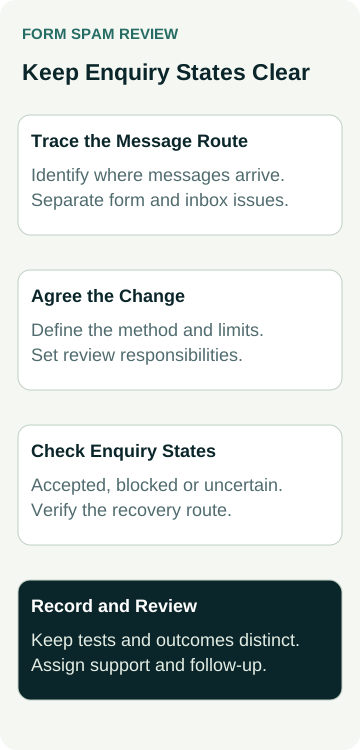
A Worked Example: A Slow Quote Request
An example exterior-cleaning business wants help with unwanted messages reaching its quote form. The owner also wants customers to have time to describe access, surfaces and the work they need.
The provider proposes a background verification service. Before agreeing, the owner asks how the form handles a customer who writes a detailed description, pauses, corrects a contact field and then submits. They also ask what happens if verification is unavailable.
The proposed test plan includes an agreed ordinary request and a recoverable failed check, using approved dummy details in an appropriate environment. It records the customer message separately from acceptance by the website and receipt at the intended business destination.
If a check blocks the request before acceptance, the reviewer records that state and assesses the recovery route. It is not counted as a stored enquiry waiting in a review folder unless the system demonstrates that behaviour. If the request is accepted but a notification is missing, the delivery gap remains unresolved.
This example describes a scope and test plan. No form has been changed, challenge completed, message submitted or filtering result measured here. A proposed test does not establish that every genuine request will pass or every unwanted message will be stopped.
Agree the Checks Before a Live Change
Ask for a controlled check of the proposed implementation before a public change. The provider should define suitable permitted test cases and the environment, with any submissions or notifications agreed with their recipients. Keep tests identifiable so they do not become genuine customer enquiries in reporting.
Include the customer route, failure messages and intended business destination. Ask the developer to assess technical validation and failure handling as well as the visible form. Checking that a badge appears is narrower than checking the integration.
Record what was tested, what happened and what remains unknown. A filter's activity count is separate from proof that the enquiry route works.
Have the provider explain how an unsuitable change would be reversed and who decides whether it can proceed. Keep the original observations and the revised results. Do not switch off protections or broaden permissions simply to make an uncertain test pass.
If continuing support is part of the proposal, agree the work and checks in the maintenance plan. Include who investigates reports of genuine customers being blocked and which later website or form changes need another check.
Review Spam and Business Outcomes Separately
Agree how staff will report unwanted submissions and suspected mistaken blocks. Keep the dates, definitions and known collection limits with any comparison. Fewer notifications can result from several causes, including a changed form or a delivery problem, so investigate before attributing every decrease to successful filtering.
Keep attempted submissions, accepted requests, suitable enquiries and paid jobs separate. Passing a technical check does not establish that a message is a useful customer enquiry. A reduction in unwanted messages does not establish an increase in sales.
Bring the affected website address, redacted examples and the customer route you need into a discussion of AWE's website packages and support. Ask what assessment and changes suit the actual site, then confirm the checks, limits, ongoing responsibilities and fees in the proposal.