

To be considered for Google's AI Overviews, your page needs to be discoverable, indexed and eligible to appear with a search snippet. You should also check the site's Search generative AI inclusion control in Search Console. Then focus on providing useful, reliable information that answers the reader's question.
Eligibility is a starting point. It does not guarantee that Google will select your page for a particular answer. There is no fixed “number one AI Overview position” that a website owner can switch on.
Google's current generative AI optimisation guide ties the work to its core search systems and highlights useful original content. Here is how we'd apply that guidance to an Australian business website.
AI Overviews and AI Mode are different experiences
An AI Overview is a generated response that can appear within a search results page. AI Mode provides an experience for more involved questions and follow-up exploration. Both can include links to supporting pages, but don't assume they will select the same sources or produce the same answer.
Record which experience you checked. “We appeared on Google AI” is too vague to make a useful comparison later.
A real search example, with its limits
On 28 September 2026, we searched Google for “what is generative engine optimisation”, using an Australia-targeted search in English. The result displayed an AI Overview with linked sources alongside and within the response.
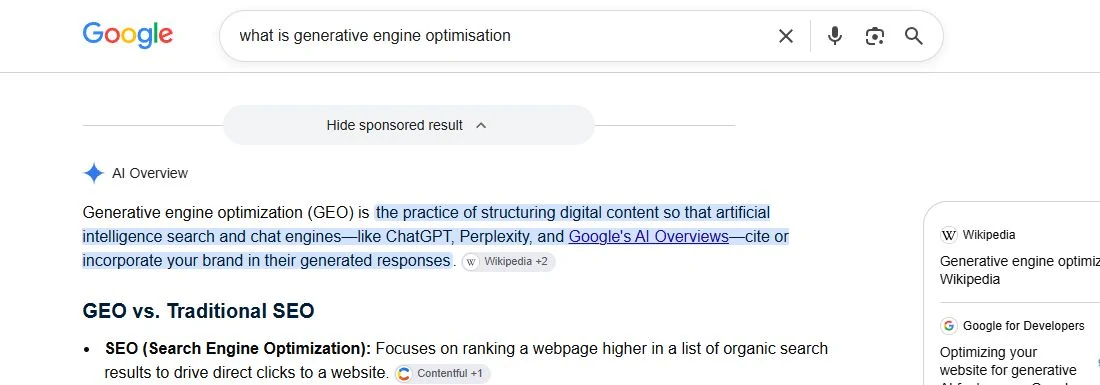
There are three useful things to notice. The AI Overview is a separate component from the ordinary results below it. Its source cards link to specific resources, including Google's own guidance. And the displayed answer can contain several source references rather than one winning website.
The screenshot establishes what appeared in that search. It does not establish why Google selected each source, whether those sources always appear, or what an Australian business would need to change to replace one of them.
When reviewing your own market, preserve the query, date and context alongside the result. If an AI Overview does not appear, record that too. A missing feature and an absent business are different observations.
Check eligibility before rewriting content
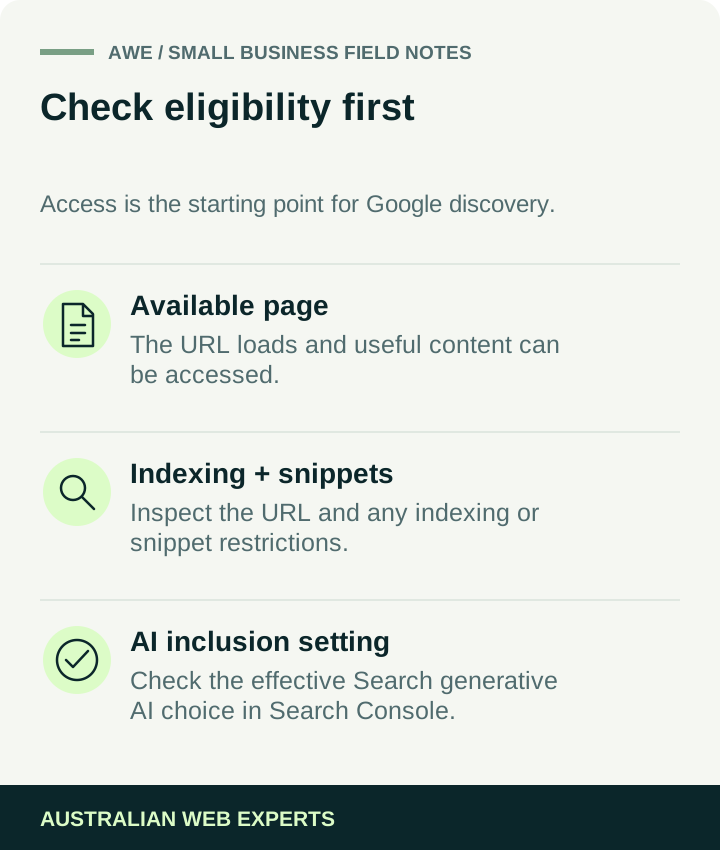
Start with the exact page you want people to find. Does it load normally? Is it available without a login? Can search systems access its important content? Does it have an accidental instruction preventing indexing or snippets?
Use Search Console to inspect the URL and its indexing status. A page being online does not mean it has been indexed. Use our access, crawl and index evidence record to keep those observations and their dates separate. Ask your specialist to explain any excluded status and the evidence behind the proposed fix. Google's Search Essentials sets out the basic technical and policy framework.
Also review Settings → Search generative AI for the relevant Search Console property. Google's control documentation describes inclusion, exclusion and inheritance from a parent property. The default is inclusion, but you should verify the effective choice rather than assume it. Check the owner's intention before changing an existing exclusion.
This setting is separate from an ordinary content edit. It doesn't guarantee selection and should not be confused with model-training preferences.
Improve the page around a real customer decision
Imagine a fictional business that replaces commercial flooring. A buyer asks whether work can happen while the premises remain open. A useful answer would explain which site conditions matter, how staging is assessed and what the business needs to know before proposing a schedule.
That may require input from the person who plans the work. A writer cannot invent the answer by rearranging keywords.
Our editorial approach would be to state what can be answered generally, explain the important conditions and show a relevant example where one is available. Link to the service page and give the reader a sensible next step. If a site assessment is needed, say why.
To plan conventional search pages alongside this work, match your reported Search Console queries to the services you actually offer. The worksheet keeps observed page addresses separate from proposed targets.
Our answer engine optimisation guide includes a worked editing example. The aim is a more useful page, without assuming a particular paragraph format will force Google to cite it.
Don't build the campaign around a special file
Google says it doesn't require special AI markup, an llms.txt file or a particular writing format for its generative search features. Those are not substitutes for useful content and a working website. Its current guide addresses these claims directly.
Ask a provider what customer problem an extra technical deliverable solves. If structured data is appropriate, it should describe the real content accurately. A plugin installation alone doesn't establish better visibility.
A diagnostic checklist you can use
| Check | Evidence to keep | What to do with the finding |
|---|---|---|
| The intended URL loads correctly | URL and response check | Fix failures before content work |
| The page is indexed and can show a snippet | Search Console findings | Investigate specific restrictions |
| The property allows Search generative AI inclusion | Effective setting, including inheritance | Resolve unintended exclusion with the owner |
| The page answers the customer's question | An editorial review with missing details marked | Add facts and examples the business can verify |
| An AI feature appeared in a test | Query, date, context and screenshot | Record the actual sources and response |
| Visitors can take the next step | Mobile page and enquiry-path check | Correct obstacles to a useful enquiry |
Work through the rows separately. Passing the first three does not prove the last three, and a successful enquiry-path check does not prove that Google has selected the page.
Before applying a published AI statistic to your business, check its population and period in our website, search and AI statistics reference.
How to measure Google AI visibility
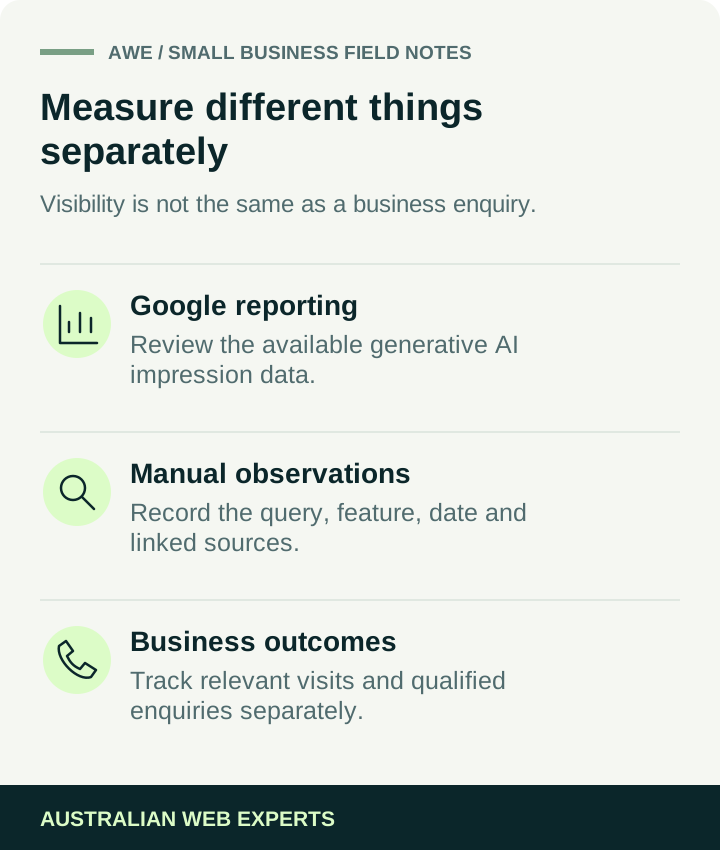
Google now documents a Generative AI performance report in Search Console. It reports impressions for supported generative search features and allows analysis by dimensions including pages, countries and devices. Check whether it is visible for your property and whether enough data has accumulated.
Use it alongside ordinary search performance and your enquiry reporting. Don't describe impression counts as clicks or completed sales. Keep manual screenshots as contextual examples rather than using them to replace the site's own performance data.
Our AI search measurement guide shows how to combine these different observations in a report without double-counting or overstating attribution.
What to work on next
If access or inclusion is the problem, resolve that first. If the page is available but too vague to help the reader, improve it with the person who knows the service. If it already answers the question well, investigate the actual search and enquiry data before deciding that a full rewrite is necessary.
For a broader starting point, use our AI search optimisation guide. If you'd like help identifying which issue applies to your website, talk to our team with the URL and the customer question you want it to answer.
Updated 1 October 2026. Prepared by Australian Web Experts with AI-assisted drafting, source checks and worked examples. Platform guidance checked 28 September 2026; interfaces and reporting may change. Fictional examples are labelled in the text.