

To track AI search visibility, record a fixed set of customer questions and check whether your business is mentioned, recommended or linked in the answers. Keep the test conditions visible, repeat the checks, and report visits and enquiries separately.
A favourable screenshot is useful evidence of one response. It is not a complete monthly report. You need to know what was tested, how often it happened, whether the information was accurate and whether the business received useful enquiries.
This guide includes a free CSV worksheet and a worked calculation you can use without buying a specialist reporting platform.
Decide what you are measuring
Before testing anything, define the measures. Otherwise it is easy to compare different things under the same label.
| Measure | What to record | What it tells you |
|---|---|---|
| Brand mention | Whether the response names your business | The name appeared in that answer |
| Recommendation | Whether it suggests the business as an option for the user's need | A recommendation occurred in that test |
| Linked citation | The exact URL linked as a supporting source | A page was referenced |
| Accuracy | Incorrect services, coverage, details or claims | Whether the visibility may mislead a reader |
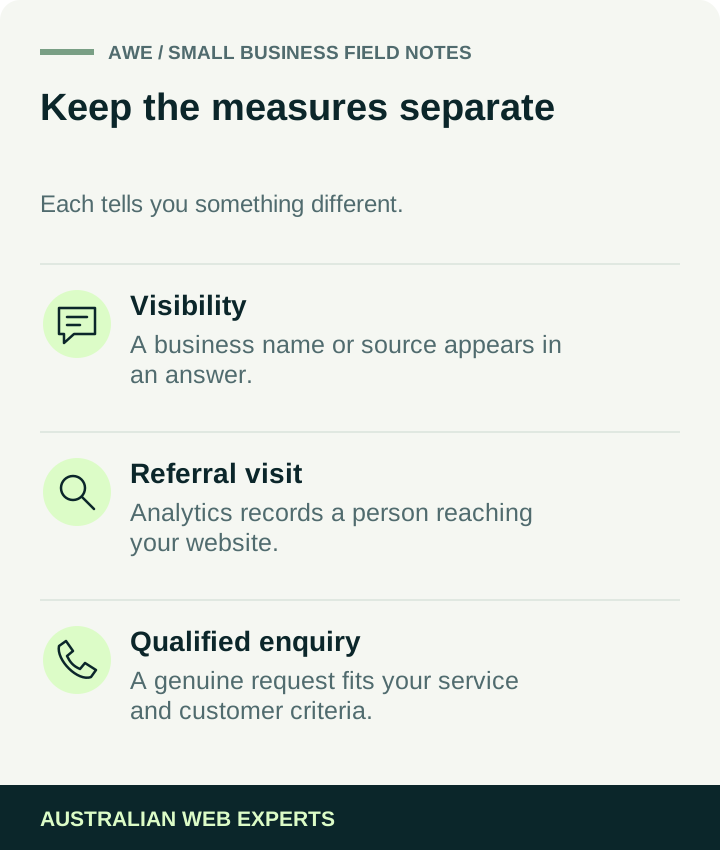
| Referral visit | Visits attributed to a relevant source in analytics | Some people reached the website |
| Qualified enquiry | An enquiry that fits your defined customer criteria | A potential business outcome |
These measures should not be added together into one total. A response can mention a business, recommend it and cite its website at the same time. Counting that as three separate customer discoveries would be misleading.
Our GEO explanation includes an example of the difference between a mention, citation and recommendation.
Choose questions before seeing the answers
Start with the questions a prospective customer asks while deciding what they need and who to hire. Include a mix of research, suitability, comparison and provider questions.
Keep branded checks separate. Asking “What does Example Plumbing do?” tests whether the tool describes that name accurately. Asking “How should I choose a hot water installer in Geelong?” tests a different discovery situation.
Write down the exact questions and keep them stable for a reporting period. If you change the set, record the change and start a clearly labelled comparison. Quietly replacing unfavourable questions with favourable ones makes the report look better while reducing its usefulness.
You can begin with ten questions relevant to one service. Ten is a manageable example, not a claim that ten questions represent your market.
Record the conditions and the complete result
Download the AI visibility tracker CSV. Open it in Excel, Google Sheets or another spreadsheet tool. It includes two clearly labelled fictional example rows and a blank row for your first real observation. Remove the example rows before calculating your own results.
For each check, record the platform, date, exact question, location context, whether search was used and the conversation conditions. Save the complete response or a screenshot, with a reference in the sheet. Record the exact linked page rather than only the domain.
Use fresh conversations for repeatable baseline checks and note any settings that could affect the answer. Don't mix a personalised conversation that already discussed your business with a fresh unbranded test without labelling the difference.
If a tool fails, the response is incomplete or you can't establish whether search ran, record that. Missing observations should not be silently treated as successful answers or as proof of invisibility.
For the populations and periods behind published digital figures, use our Australian small-business statistics reference.
A worked visibility calculation
Suppose you test ten questions three times on the same platform, producing 30 valid observations. These numbers are fictional and used only to demonstrate the arithmetic.
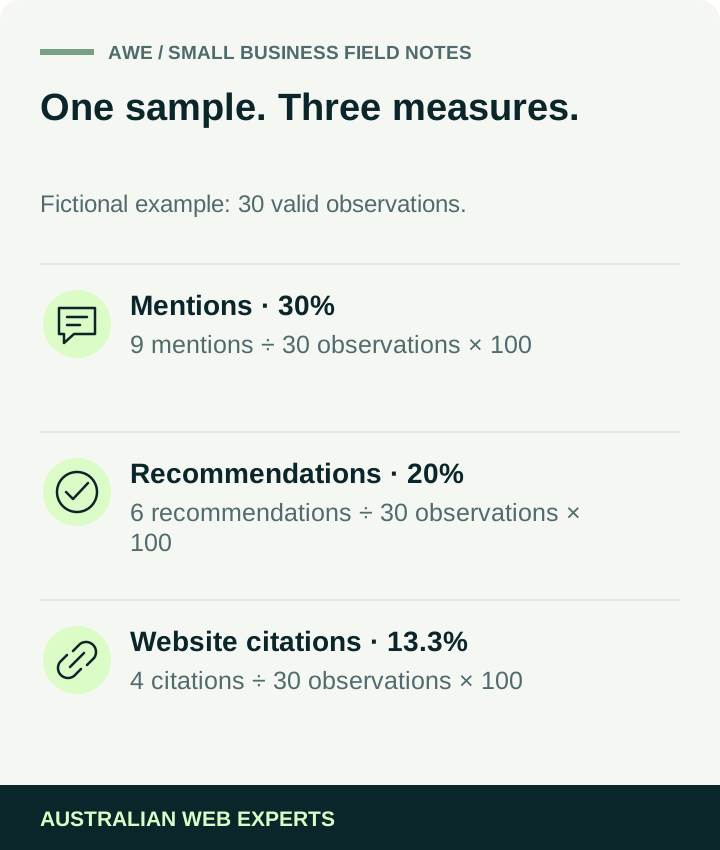
Your business is mentioned in 9 responses, recommended in 6, and your website receives a linked citation in 4. The sample rates are:
- Mention rate: 9 ÷ 30 × 100 = 30%.
- Recommendation rate: 6 ÷ 30 × 100 = 20%.
- Website citation rate: 4 ÷ 30 × 100 = 13.3%.
Call these rates for the tested questions and conditions. They are not your share of all AI searches, the percentage of Australian customers who see you, or the probability that the next user receives the same answer.
If two additional attempts failed, record 32 attempts, 30 valid observations and 2 failed attempts. Keep the denominator explicit. For a Google feature that didn't appear, distinguish a feature-appearance rate from the citation rate among observations where the feature appeared.
If several responses are inaccurate, report that alongside the rates. A high mention rate with the wrong service area can be less useful than a smaller number of accurate, relevant recommendations.
Use Google's own reporting where available
Google documents a Generative AI performance report for Search, covering impressions in supported features such as AI Overviews and AI Mode. It can group data by page, country, date and device. If it is absent, investigate the property's eligibility and available data rather than assuming that no AI visibility has ever occurred.
Keep that report distinct from your manual prompt sample. It measures actual impressions under Google's reporting definitions, while your worksheet records a set of deliberate tests. Neither should be relabelled as completed enquiries.
The Google AI Overviews guide explains the relevant inclusion setting and shows a dated live-search example. Your property data is more useful for assessing your own performance than copying another business's screenshot.
Connect visibility with visits and enquiries carefully
Where analytics identifies referral visits from AI products, inspect which pages people reached and whether they took a useful next step. Record the date range and the attribution method used.
Some customers may see your name in an answer and later search for it, type the address or call directly. Some visits may lack clear referral information. That makes attribution incomplete; it doesn't justify assigning every unexplained enquiry to AI search.
An optional “How did you hear about us?” field can add context, provided it doesn't make enquiring difficult. Treat the response as self-reported information. Keep personal details in your normal customer system rather than a public visibility worksheet.
Define a qualified enquiry before reporting it. For a local trade, that might mean a genuine request for an offered service within the actual service area. Spam, recruitment messages and requests for unrelated work should not inflate the result.
Use the enquiry, job and payment log to record one potential job per row, set the business's qualification rules and keep source evidence separate from later outcomes.
A monthly report a business owner can use
Keep the report short enough to understand and specific enough to act on. Include the work completed, the test set, observed visibility, accuracy issues, available traffic and enquiry data, and the next action supported by the findings.
For example, “Our service area was wrong in three saved responses; we corrected the outdated profile and will recheck it” is useful. “AI authority improved by 47 points” is difficult to assess without a published definition and evidence.
Avoid claiming that a new paragraph caused an increase simply because the increase followed the edit. Platforms, competitors, seasonality and the test sample can also change. Keep a change log and explain what you can establish.
When should you change the strategy?
Review whether the questions still represent customers you want. Check whether the cited pages answer those questions and whether visitors can make an enquiry. Repeatedly inaccurate answers may point to a public-information problem; relevant visits without enquiries may point to an offer or website problem.
Use the findings to choose the next task, rather than publishing more articles automatically. The AI search action plan helps organise that work, and the ChatGPT guide covers checks specific to that platform.
If your current reports leave you unsure what is happening, talk to Australian Web Experts. Bring the reports and the services you want to grow so we can identify which useful evidence is missing.
Updated 1 October 2026. Prepared by Australian Web Experts with AI-assisted drafting, source checks and worked examples. Platform guidance checked 28 September 2026; interfaces and reporting may change. Fictional examples are labelled in the text.