

AI search optimisation for a local business starts with a clear description of your services, genuine coverage and the information a customer needs before booking. Keep those details accurate on your website and relevant public profiles, then check how your business is described in answers to local questions.
The practical goal is a suitable enquiry. Being mentioned for a suburb you don't service or a job you don't take on creates work without creating a useful customer.
If you run a trade, professional practice or another local service business, the checklist below will help you identify what to improve first.
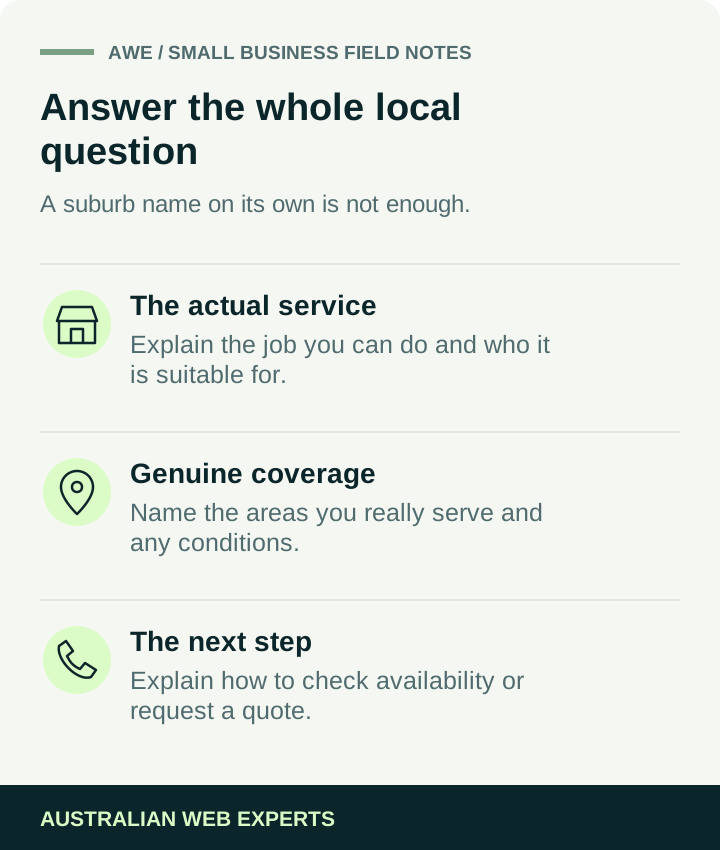
Think about the customer's whole question
A customer rarely wants “a business with good AI optimisation”. They want someone who can solve a specific problem in a particular place.
A fictional question might be: “I need an electrician to install a home EV charger in Geelong. What information should I send for a quote?”
The location matters, but so do the service and the next step. A website listing dozens of suburbs without explaining its installation process still leaves the reader with basic questions.
Ask the person who handles enquiries which details determine whether a job is suitable. Those details belong in your content plan. They may include job type, property type, equipment, timing or access requirements.
Describe where you genuinely work
State your service area in language a customer can use. If you cover a region, explain any important boundaries or conditions. If some jobs require a travel charge, explain how the customer can confirm it before booking.
Do not imply you have a staffed office in every suburb you mention. A genuine service area and a physical business location are different facts. If customers cannot visit your premises, make the booking arrangement clear.
For businesses that serve both local and national customers, identify which services apply to which audience. Our local SEO and traditional SEO comparison explains why the intended customer matters when deciding what to target.
Give each important service enough detail
An effective service page should help a reader assess suitability before they call. For a fictional electrician, that could mean explaining whether the business handles residential installations, whether an assessment is needed and what information helps prepare a quote.
For a cleaning company, the key distinction may be between regular office cleaning and a one-off builders clean. For a bookkeeper, it may be whether the service includes payroll, catch-up work or ongoing support.
Avoid claiming qualifications, response times or availability you haven't verified. If the answer depends on the job, describe the variables and tell the reader how to confirm their situation.
Use the service-page decision worksheet to compare the customer questions, scope and available evidence before adding a separate page for an offered service.
The AEO writing example shows how to make service copy more specific without inventing promises.
Check the public facts people use to assess you
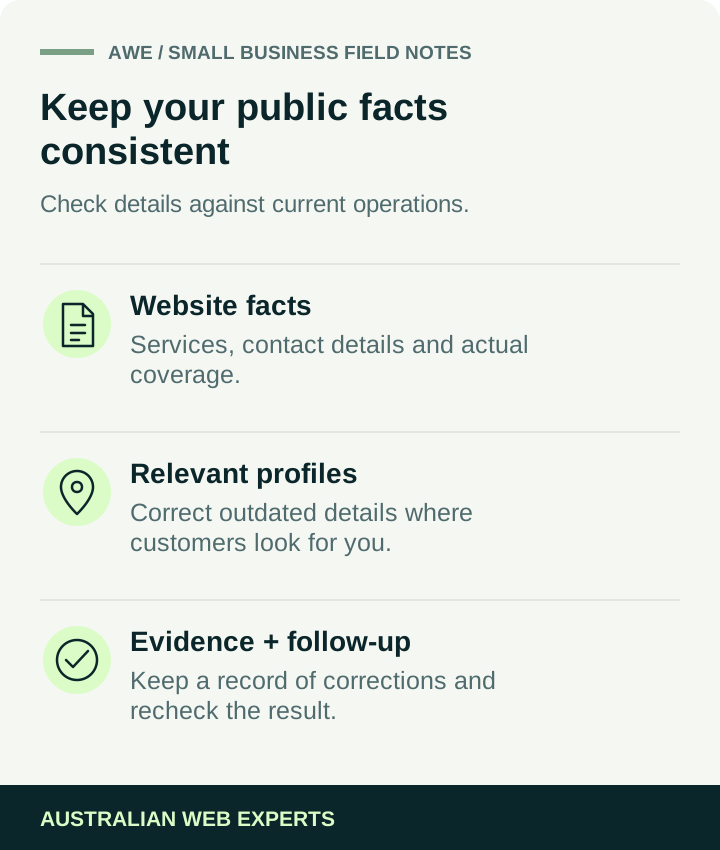
Review your business name, phone number, website, service description and opening arrangements on the profiles that matter to your customers. Correct old details rather than creating another profile to compete with them.
For Google specifically, its local ranking guidance describes relevance, distance and prominence, and recommends complete, accurate Business Profile information. That is Google guidance; it isn't evidence that every other AI product reads or weighs the same information in the same way.
Use relevant Australian business directories selectively. A listing is useful when it is accurate and belongs somewhere a customer might reasonably look. A large quantity of unrelated directory entries is not a meaningful outcome by itself.
A worked audit for a fictional local business
Imagine “Example Electrical”, a fictional Geelong electrician. The following findings are invented to demonstrate the review process. They are not observations about a real company or a claimed case study.
| Item | Illustrative finding | Recommended action | How to check completion |
|---|---|---|---|
| EV charger service | Only mentioned in a list on the homepage | Add a clear explanation of scope and quoting requirements | Owner confirms the facts on the live service page |
| Service area | One page says Geelong; another says all Victoria | Correct the wording to the actual coverage | Review every page where coverage is mentioned |
| Contact details | An old directory has a retired number | Request a correction | Reopen the public listing after it updates |
| Project evidence | Photos have no explanation | Add a factual project description with permission | Reader can understand the job and the work performed |
| Enquiry process | Customer doesn't know what details to send | Add a short preparation list | A new reader can follow the next step |
| Measurement | No record of AI answers or referrals | Establish a dated baseline | Save the questions, responses and relevant analytics |
Download the local business review worksheet to record your own findings, owner and verification date.
None of these changes guarantees an AI recommendation. They resolve identifiable information problems and make the business easier for a customer to assess. Visibility is something to check after the work, not something to assume from the checklist.
Add proof without exposing your customers
A useful project example explains the customer problem, the work performed and relevant limitations. A genuine photo may help, but it needs enough context to tell the reader what they are looking at.
Use the job-photo gallery selection sheet to choose relevant images, record permission evidence and prepare factual captions.
Obtain permission before publishing identifying customer details or photographs of private premises. If you anonymise a project, say so where it affects the reader's understanding. Don't present stock photography as a completed job.
The same principle applies to reviews and credentials. Link to genuine sources where appropriate, make sure qualifications are current and avoid rewriting feedback into a stronger claim than the customer made.
You can also explain how your process works. A clear account of how you assess a job or prepare a quote can be useful even when you don't have permission to publish a detailed customer story.
Test local questions consistently
Use a small set of questions tied to the jobs you want. Record the location included in the question and any location context shown by the platform. Keep branded checks separate from unbranded discovery questions.
If the tool recommends providers, inspect whether they match the requested job and area. If it names your business incorrectly, save the answer and inspect the sources it links to. A mention outside your coverage should be flagged as an accuracy problem, not celebrated as extra reach.
Our ChatGPT guide explains the platform-specific access checks. The Google AI Overviews guide covers Google's eligibility and reporting. Use the AI visibility tracker to record observations under comparable conditions.
Prioritise the work that affects real enquiries
Fix incorrect contact details, broken pages and misleading service descriptions first. Then improve the pages for the services you want to grow. Add supporting content when it answers a question that those pages cannot reasonably cover.
Do not commission a page for every nearby suburb simply because the suburb can be inserted into a heading. A separate page should have a real purpose and enough distinct information to help the people using it.
Our local SEO services cover your website, business information and genuine service area.
For a plan that also reviews how those services appear in AI-assisted search, explore our AI SEO service for small businesses.
If you'd like help choosing the first service page to improve, contact Australian Web Experts with your website, the jobs you want and the areas you genuinely service. Our AI search work plan gives you a broader checklist for organising the project.
Updated 1 October 2026. Prepared by Australian Web Experts with AI-assisted drafting, source checks and worked examples. Platform guidance checked 28 September 2026; interfaces and reporting may change. Fictional examples are labelled in the text.