

Compare the website, the ongoing work and the commitment before choosing between monthly payments and an upfront build. Ask what each payment buys, when it starts and ends, and what you can keep using if the arrangement changes. The payment label alone does not answer those questions.
A monthly amount might pay for an ongoing service, spread the build fee over instalments, or combine several things. An upfront project can still have separate recurring costs. Ask each provider to describe its actual arrangement in writing so you can compare the same work over the same period.
Before comparing totals, find out what happens when the initial payments finish. The website, hosting and support may have different arrangements.
Find Out What the Monthly Fee Pays For
Ask the provider to separate the build from any continuing services. Is the monthly fee an instalment towards a fixed project amount? Is it a subscription that continues while you use the service? Does it include both the initial build and ongoing work? Request the explanation for the proposal in front of you.
Check whether the payment changes after an initial term. If the build portion finishes, ask which charges continue and what they cover. If the whole fee continues, ask which work or access continues with it. Keep the answer alongside the page list and other inclusions.
Do the same for an upfront quote. Identify any deposit, progress payments and final payment, then list the services that will be billed separately after launch. Paying for the build does not tell you who will maintain the site or how hosting will be arranged.
Business.gov.au’s guide to setting up a business website distinguishes cloud-based CMS subscriptions from self-hosted systems that use separate hosting. That is another reason to identify the proposed platform and services rather than infer them from the payment schedule.
Compare the Same Website and Support Work
Give both providers the same customer task and content needs. For an example service business, that might mean explaining the services and service area, showing approved project information and letting a customer request a quote. Confirm the pages, content preparation and enquiry features each proposal includes.
Then compare the work after launch. Who handles technical updates? What content changes can you make yourself? What help can you request, and what falls outside the fee? A list saying “support included” needs enough detail to understand the work offered.
Our website maintenance plan guide develops that ongoing-work discussion. Use it when support is bundled into a monthly website arrangement or proposed separately from an upfront build. Keep the maintenance scope distinct from payment for creating the site.
You may decide that one proposal includes useful work the other leaves with you. Record that difference before comparing costs. Otherwise, the apparent saving may depend on you supplying content, managing updates or arranging another service that has not yet been priced.
Check When Payments Start and End
Ask what triggers the first payment. It could be signing, a project milestone, launch or another agreed event. Have the provider explain what happens to the payment schedule if content is delayed or the project needs changes. Avoid relying on an assumed launch date.
For a recurring arrangement, identify the minimum term, billing frequency and any setup charge. Ask what happens at the end of that term: whether payments stop, change or continue, and what notice is required for a change. A monthly invoice does not by itself explain the length of the commitment.
Business.gov.au’s contract preparation guidance covers describing the work, fee calculations, tax treatment, payment timing and completion conditions. It is general guidance for contractors and hirers. Use those topics to request a clear explanation of your proposed website arrangement.
Keep unclear terms open until you understand them. If you need advice on the meaning or effect of a contract, ask an appropriately qualified adviser before committing. A comparison record helps you gather answers; it does not determine your legal rights or whether a particular term is enforceable.
Ask What Happens at Renewal or Exit
Request a practical explanation of a change of provider. What website files or exports would you receive? What content could you continue using? Which services or licences would need another arrangement? Ask the provider to identify any limits and assistance costs in the actual proposal.
Check the website, domain, email and third-party services separately. They may depend on different accounts and agreements. Do not assume that ending one payment moves all of them or that having an export means every feature can be recreated elsewhere unchanged.
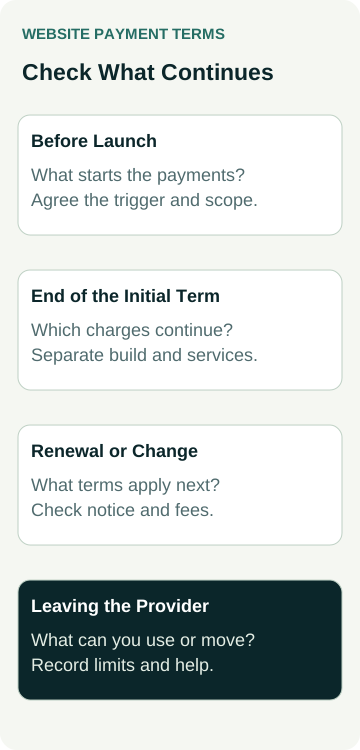
Use these four points in the discussion. Fill in the answers from each proposal, keeping unresolved items visible.
| Point in the Arrangement | Question to Resolve | Record to Request |
|---|---|---|
| Before launch | What work or event starts the payments? | Payment trigger and handling of project delays |
| End of the initial term | Which payments stop, change or continue? | Continuing services, fees and any remaining build amount |
| Renewal | What continues, and how can the arrangement change? | Renewal process, notice requirements and applicable terms |
| Leaving the provider | What can the business keep using or move? | Available files, usage limits, dependencies, fees and help |
Ask about an early exit as well as the ordinary end of a term. Have the provider identify the relevant conditions and possible charges. Keep this as a request for clarification rather than assuming that all subscriptions or all upfront builds have the same exit path.
A Worked Example: Payments End but Hosting Continues
Illustrative planning example only: these are invented proposal structures, not AWE offers, market averages or legal conclusions.
An example gardening business compares two proposals for the same agreed website. Proposal A describes a build paid in instalments, with hosting and support quoted separately. Proposal B describes a continuing monthly website service. The owner initially compares only the amounts due in the first month.
The owner asks Proposal A’s provider when the build instalments finish and which ongoing charges remain. Proposal B’s provider is asked what happens after the minimum term, which services continue and what the business can take to another provider. Neither proposal is marked complete until those answers are clear.
The comparison now separates payment for the build, continued operation and the conditions for a change. The owner can consider available funds and the help the business needs without assuming that one payment model automatically provides more control or better support.
The example does not establish which proposal is cheaper or better. No prices, actual permissions, completed website or customer results have been supplied. Its purpose is to expose questions that a first-month price comparison would miss.
Compare Costs Without Predicting a Return
Choose a common period that fits your planning and covers the proposed minimum term. Use the actual supplied fees for the build, recurring services and known renewals. Keep the tax treatment consistent, identify optional work separately and mark missing amounts as unknown.
Show when payments fall due as well as the total. Two arrangements can have similar totals and very different payment timing. Ask what assumptions the comparison depends on, including whether prices stay fixed and whether you keep every service for the whole period.
For the broader buying discussion, our questions to ask before accepting a website quote cover scope, costs, access and handover. That guide also includes a labelled example calculation. Use figures from your own proposals when making a decision.
A cost comparison does not show that the website will pay for itself. Enquiries, suitable jobs and payments received require their own evidence. Avoid choosing a commitment on the strength of an unsupported claim that one extra customer will cover it.
Choose an Arrangement You Can Explain
Before accepting, explain the proposed arrangement back in plain language: what will be built, what the payments cover, when they change or end, who handles ongoing work and what happens if you leave. Put any gap back to the provider and ask for the answer in the written scope.
Your choice can reflect how you want to pay and how much work you want to manage. It should also reflect the website and support actually offered. Keep the agreed records available to the person responsible for the site so later changes can be checked against them.
When discussing website packages with Australian Web Experts, bring your required customer tasks, expected updates and questions about payment and handover. Ask which arrangement the proposal offers and what it includes before deciding whether it fits your business.