

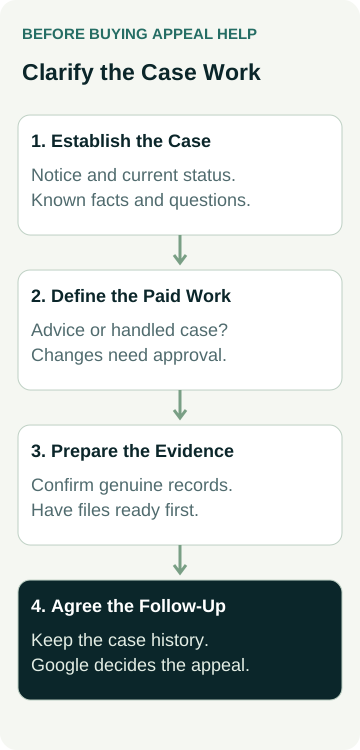
A suspended Google Business Profile can leave a business owner looking for urgent help. Before paying someone to handle it, ask for a written scope covering the profile review, proposed corrections, evidence preparation, appeal submission and follow-up. Separate the work you are buying from the decision Google will make.
You can use Google's appeal process yourself. Paid help may be useful when you need someone to interpret the notice, check the facts or coordinate the paperwork. The useful comparison is what each provider will actually do for your case, what you must supply and what happens if the first decision is unfavourable.
Start with the notice and the current case status. A broad promise to “get you back on Google” leaves too much unanswered to compare quotes fairly.
Establish What Needs Attention
Keep the suspension or restriction notice, the profile details and any previous appeal correspondence together. Before requesting a quote, write down whether an appeal has already been submitted and what response you received. Do not assume that an absence from a search result, a rejected edit and a suspended profile are the same problem.
Google's suspended-profile guidance says to check compliance before appealing. Its appeal tool identifies the restricted profile, moderation reason and relevant policy. The same guidance describes a separate account-restriction route. Ask the provider which issue they are assessing and which official instructions apply.
A useful initial response should identify what is known, what still needs checking and whether further information is needed before recommending action. “We haven't established the cause yet” can be a reasonable answer. A confident diagnosis made without seeing the notice or business facts deserves a follow-up question.
Give the reviewer the real operating facts: what the business does, where customers are served, how the location is used and which details have recently changed. They need to understand the business represented by the profile. Avoid changing factual information simply to fit a guessed explanation of the suspension.
Compare the Deliverables in Each Quote
Ask providers to break the work into review, correction, preparation and follow-up. These are comparison questions, rather than a claim that every case needs the same tasks or every agency includes them.
| Work to Clarify | What to Ask | Record to Expect |
|---|---|---|
| Case review | Will you review the notice, profile, business facts and previous appeal history before proposing action? | A written finding, with unresolved questions identified. |
| Corrections | Which changes do you recommend, why, and who approves and makes them? | The proposed changes and a record of the changes actually made. |
| Appeal preparation | Will you assess the available evidence, prepare the wording and submit, or advise me to submit? | The agreed submission wording, evidence list and submission confirmation. |
| Follow-up | Who checks the decision, explains it and handles any further work? | A status update, copies of correspondence and a clear next-step scope. |
A quote for advice only can be useful if you are comfortable making the changes and submitting yourself. A quote for handling the case should explain where the provider's responsibility starts and ends. Neither label tells you how thorough the review will be.
Check whether the quoted fee covers only an initial review, an initial appeal, or an agreed follow-up after a decision. Ask what creates an extra fee and what happens if the provider concludes that the case cannot proceed as expected. Get the answer before committing, including any conditions attached to a refund or outcome-based payment.
Keep unrelated website improvements, review campaigns and ongoing local SEO in a separate part of the discussion. They may be useful later, but a bundle should still show which work addresses the present restriction. You should be able to compare the immediate job without having to buy a broader campaign by default.
Prepare Evidence Before the Submission
Ask for a case-specific evidence list and name the person who can obtain each item. A provider cannot confirm business facts that only the owner knows, or produce a genuine record the business does not have.
Google lists business registration, licences, tax certificates and business utility bills as possible supporting evidence. It advises checking that the business name and address match the profile. These are examples, rather than a promise that one document will resolve every case.
Agree how the provider will review the available records and handle discrepancies. If a document raises a question about the business details, resolve that question before approving the submission. Do not alter a document or invent operating facts to make a case look simpler.
Have the intended files and responsible person ready, and follow the current instructions shown for your case. An appointment to begin an appeal should not be the first time anyone checks whether the paperwork is available.
Ask how documents will be collected, who can access them and what happens to them after the work ends. Give the provider what the agreed case needs through an appropriate sharing method. Keep your own copy of the records and submission so another person can understand the history later.
Keep Ownership and Authority Clear
The engagement should explain who can view the profile, make changes and communicate on the business's behalf. It should also identify the owner who approves the proposed action. Paying for help should not leave you unable to see what was done.
Google's third-party policies require customers to retain ownership or co-ownership. The account setup guidance recommends inviting a provider as a manager for an existing profile. It also requires transparency about changes and fees, and prohibits misleading claims of affiliation with Google.
Ask the provider to explain the access needed for the particular work. If the current restriction prevents an ordinary access arrangement, establish the applicable official route before proceeding. Do not treat a suggestion to move ownership or create another account as a routine fix without understanding the reason and consequences.
Your written instructions can be short:
- Identify the exact profile and the work being authorised.
- Name the person who approves changes and submission wording.
- State how case records and progress will be shared with you.
- Confirm how access and documents will be handled when the job ends.
These instructions help keep the job understandable. They also make it easier to distinguish an approved correction from a change nobody discussed.
A Worked Example: A Gardening Business Compares Two Quotes
Imagine a gardening business with a suspension notice and no appeal submitted yet. The owner has some registration paperwork, but has not checked which records match the details on the profile. This is an example, not an actual client case or reinstatement result.
The first quote offers appeal submission after the owner supplies documents. It does not explain whether a profile review or recommended corrections are included. The second describes a review first, an evidence check, owner approval of proposed changes and a submission record. It also identifies which follow-up is included and which would need another quote.
The owner should ask the first provider whether those missing tasks are excluded or simply absent from the description. A shorter quote does not prove poor work. It means the owner does not yet have enough information to compare the jobs.
Suppose the review then finds that a business detail needs clarification and the owner cannot confirm it that afternoon. The next step is to resolve the fact and update the case plan. It is not to approve a statement the owner cannot support just to meet a provider's preferred schedule.
Once the facts and intended documents are ready, the owner can choose who will submit and agree how the decision will be tracked. That choice depends on available time, confidence in the guidance and the actual scope offered. This process does not predict whether Google will approve the appeal.
Agree What Happens After Google's Decision
Ask who will monitor the case and when you will hear from them. A useful update states the current status, the action taken and anything waiting on you. Silence is hard to interpret when you do not know whether the provider is waiting for Google or waiting for a missing file.
Google warns against creating a new profile for the same business while an appeal is under review. Its guidance also describes a possible additional review after a denied request, with further evidence. Ask how an unfavourable decision will be assessed and whether that work is included; do not assume that repeated submissions are the agreed follow-up.
If the profile is reinstated, check the business information customers can see and the routes they use to contact you. Keep a record of the restored status and any remaining issues. Restoration, search position and customer enquiries are different observations. An approval notice alone does not show that enquiries or paid work have increased.
For broader campaign follow-through, our guide to what a monthly SEO report should include explains the evidence to ask about. A recovery case update should remain clear even if no ongoing campaign is purchased.
Make the Decision With the Scope in Front of You
Before paying, check that you can answer these questions:
- What exact issue is the provider assessing, and what remains uncertain?
- What work and follow-up does the fee cover?
- What facts, records and approvals must I supply?
- Who controls the profile and keeps the case history?
- What happens if the case needs more work or the appeal is denied?
Choose with those answers in front of you. A provider's past result or refund promise needs its own evidence and conditions; it does not tell you what Google will decide for your business. Ask about delivery commitments the provider can explain and control, such as completing the agreed review or keeping you informed.
If the discussion extends to improving your wider local presence, see our local SEO services and contact Australian Web Experts to discuss the work needed. Any suspension-related support, responsibilities and fees would need to be confirmed for the case. This guide does not establish a fixed reinstatement package.