

Ask for the evidence behind a backlink warning before approving removal requests or a disavow file. A report’s “toxic” label is a reason to investigate what the tool found. It does not, by itself, establish that the links are harming your website or that Google needs you to act.
For an Australian small-business owner, the useful buying decision is whether there is a demonstrated problem and an appropriate, defined response. Ask the provider to explain the actual links, any relevant past link-building work and the basis for recommending action. A lower warning count is not the same as a business improvement.
Google’s disavow guidance says most sites will not need its tool. It also warns that incorrect use can harm a site’s performance in Google Search. That makes this a decision to review carefully, rather than a routine upload to make a report look cleaner.
Separate the assessment from permission to act. Agree what evidence you will receive before anyone requests removals or changes an existing disavow list.
Ask What the Warning Actually Measures
Start with the report itself. Record the tool, the website it assessed, the export date and what has been counted. Does the headline number refer to individual links, linking pages or different websites? Several links from one domain should not quietly become several independent sources in the explanation.
Ask what the provider means by “toxic”, “spam” or “risk”. Which rules produced the label, and which findings has a person reviewed? A colour, score or threshold needs an explanation before it can support a recommendation.
Request examples that show the linking page, the destination on your website and the reason for concern. Keep separate entries for what was observed, what the provider inferred and what remains unknown. An unfamiliar website name or a low score alone is not a complete account of how the link was created or why a particular action is justified.
Also ask whether the link is still present. An old export can describe something that has changed. The provider should record when it checked the relevant evidence, and state any limits on the pages or data it could inspect. Nobody needs to turn every inaccessible page into a confident verdict.
Compare the Recommendation With Google’s Conditions
Google describes disavowal as an advanced feature. Its stated conditions combine a considerable number of spammy, artificial or low-quality incoming links and links that have caused, or are likely to cause, a manual action. The guidance also discusses paid links and other link schemes that violate its spam policies.
Ask how the provider’s recommendation fits those conditions. If a manual action is claimed, request the actual relevant Search Console evidence for your site. If the provider says an action is likely, ask for the reasoning and supporting link history. A tool warning should not be presented as an official notice from Google.
Google’s link-spam policy gives examples of practices intended to manipulate rankings, including buying links for ranking purposes and automated link creation. It also distinguishes appropriately qualified advertising and sponsorship links. Payment history therefore needs context; do not reduce the review to a rule that every paid mention must be removed.
The absence of a manual action does not prove that every past link-building practice was sound. Equally, a suspicious-looking export does not establish that your site has a penalty. Have the reviewer explain the evidence and the uncertainty on your actual case.
Check What Was Done in Your Business’s Name
Look for records of previous link-building work. Useful material may include agency reports, placement lists, invoices and the instructions given to a supplier. Ask who arranged the links, what was purchased and which pages were involved. Keep commercial and account records private while the reviewer assesses them.
You may have legitimate mentions alongside activity that needs closer examination. A supplier directory, local organisation, news article and purchased ranking-link package can have different purposes. Review the actual arrangements rather than treating a whole list as one undifferentiated problem.
If the history is incomplete, say so. Do not assume an unfamiliar link was bought by a former agency or deliberately placed by a competitor. A finding about a link is not evidence of who caused it.
This is a different task from deciding whether to buy new promotion. The assessment concerns existing incoming links and a proposed response. If you are commissioning an SEO audit, ask whether this investigation is included, what it will cover and how it will be handed over.
Require a Decision Record Before Action
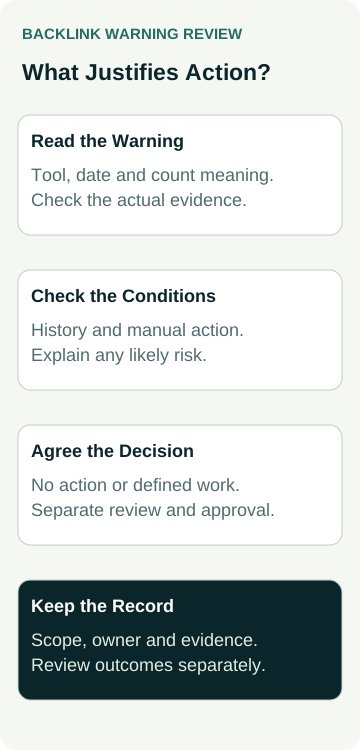
A useful review connects each recommendation to evidence. It should also allow a conclusion that no action is justified on the information available. Ask for a record you can discuss with the provider, using these four parts.
| Part of the Review | Evidence to Request | Decision to Record |
|---|---|---|
| Report finding | Tool, date, count meaning and representative links | What the warning actually establishes |
| Link history | Placement context, past work and known gaps | Why the links need further attention |
| Google-related concern | Relevant manual-action evidence or explained likelihood | Whether the stated conditions fit |
| Proposed response | Exact scope, rationale, responsible person and approval | Investigate, take no action or approve defined work |
Keep the assessment and action list distinct. A reviewer can flag a page for investigation without approving its removal or inclusion in a file. If more evidence is needed, name who will obtain it and when the decision will be revisited.
If action is justified, ask the provider to distinguish a removal request from disavowal. One asks another website to change a link; the other asks Google to disregard specified incoming links. Google’s guidance calls for trying to remove the relevant links in the circumstances it describes, with disavowal for those that cannot be removed. It does not make an unreviewed warning list a removal list.
A Worked Example: Reviewing a Backlink Cleanup Quote
This is an illustrative buying decision, not a client case or a recovery result. An example flooring business receives a report with a red backlink warning and a quote to submit a disavow file. The quote lists a score and a total, but does not explain the links or show a relevant manual action.
The owner asks for the export date, count definitions, checked examples, the provider’s reasoning and any known past link purchases. The reviewer is asked to distinguish observed facts from assumptions and explain how Google’s conditions apply.
The owner does not approve an upload while that assessment remains incomplete. That is not a finding that all the links are harmless. It is a defined pause in the proposed action until the provider supplies enough evidence for the decision.
If the investigation later identifies documented manipulative link-building activity, the owner can assess a specific response with a knowledgeable provider. The work should have its own scope and approval. Neither the example nor a tool score predicts the site’s future rankings.
Define the Work and Preserve the Existing Record
Before approving any response, ask for its exact reach. Which pages or domains are proposed, why are they included, and who has reviewed them? A domain-wide proposal needs an explanation of that wider scope. Do not let a broad action slip into the work merely because it is quicker to prepare.
If a disavow file is genuinely warranted, have the responsible specialist verify the applicable property and existing list before making changes. Google says uploading a new list replaces the existing list for that property. Its tool also does not support Domain properties. Those details need competent review; they are not an invitation to create new properties or upload a file from this article.
Agree how the existing record, proposed changes, approval and submission evidence will be retained. Keep removals, file changes and any manual-action review work separately identifiable. External requests should be approved as part of the scope, with clear wording and responsibility.
Ask what happens if the investigation supports no cleanup. A paid assessment should still deliver a useful explanation, including its limits and the next review trigger. Avoid a package whose only possible conclusion is more paid action.
Review the Outcome Without Promising Recovery
Agree how the provider will report what it actually did. A completed review, a sent removal request, a removed link and a submitted file are different states. Google also says disavowed links can continue appearing in its Links report, so a remaining entry alone does not establish that a submission failed.
Record the dates and any other website or marketing changes. If search performance later changes, compare appropriate completed periods and relevant pages or queries. A rise after an upload does not, by timing alone, prove what caused it. No cleanup quote should promise a particular recovery date, position or revenue result without a sound basis.
- Assessment: evidence, reasoning and limitations supplied.
- Implementation: only the agreed action completed, with its record.
- Search review: comparable performance evidence, with other changes considered.
- Business review: suitable enquiries, accepted work and attributable revenue considered separately.
Australian Web Experts’ SEO agency services provide a starting point for discussing search work. Bring the warning and the proposed action, then ask what assessment your situation needs. Agree the evidence and responsibilities before paying to change links simply to clear a dashboard warning.