

Ask to see the actual Search Console finding before buying a manual-action recovery service. A drop in clicks, a backlink score and a notice from Google need different investigations. The proposal should identify which problem has been established, what the provider will change and how completion will be checked.
For an Australian business owner, the immediate decision is how to commission the right work without paying for a diagnosis that has already been assumed. Keep the original finding, proposed changes and Google's eventual response as separate records.
Confirm What Google Has Reported
Google describes a manual action as a human review finding that pages breach its spam policies. Its Manual Actions report guidance explains where the notice appears and how to read the issue and affected-page patterns. The action can concern part or all of a site; examples or patterns need careful interpretation.
Ask the person assessing your site to show the relevant property, issue description, affected scope and observation date. A cropped screenshot saying “penalty” leaves too much unresolved. Record what the report actually says without copying private account information into an ordinary enquiry.
If the report shows no manual actions, that does not establish that every SEO practice is sound or that nothing needs fixing. It means a claim about a current manual action needs different evidence. Google's traffic-drop investigation guide covers several possible causes, including technical problems, ranking-system changes, security issues and changing search interest. A falling chart alone cannot choose between them.
A security warning also deserves its own assessment. Google's Security Issues report concerns findings such as hacked content or harmful behaviour. Ask who is competent to investigate that finding and what the proposed work covers. Do not assume a general SEO quote includes security remediation.
Choose the Assessment Before the Repair
Explain what you know when requesting a quote. There is a useful difference between “we have this named issue in Search Console” and “our enquiries fell and someone suggested a penalty”. Both can justify investigation, but they do not justify the same predetermined repair.
Ask for the assessment's output in plain terms:
- The finding that can be demonstrated, with its source and date.
- The pages or patterns reviewed and any limits on that review.
- The reason each proposed change addresses the identified problem.
- Work that needs a different specialist, more evidence or separate approval.
- The next decision if the evidence does not support the original diagnosis.
Our audit or ongoing campaign guide helps separate assessment from implementation. For this task, make the reported issue and the resulting change plan explicit rather than treating “recovery” as a complete scope.
Put Five Decisions in the Recovery Brief
Use the following record when discussing a proposal. It is a buying checklist, not a diagnosis or instructions to change an unseen website.
| Decision | Evidence or Agreement to Request | Who or What Must Be Named |
|---|---|---|
| What has been established? | Current report, issue wording, affected scope and unresolved questions | Person assessing the finding and the date |
| What will change? | Proposed pages, content or other corrections tied to that finding | Implementer, dependencies and exclusions |
| What needs approval? | Exact changes and any external requests before they happen | Business approver and limits of authority |
| Who handles review? | Readiness checks, proposed submission and saved acknowledgement | Responsible representative and account access |
| What counts as completion? | Live change record, Google's response and later performance review kept separate | Handover contents, follow-up owner and next trigger |
Ask what happens if the investigation finds a wider problem than the quote allowed for. A clear scope can include a point where the provider stops, explains the new evidence and quotes the additional work. That is easier to assess than an undefined commitment to keep “fixing SEO”.
If the issue involves incoming links, use the backlink-warning review guide for the separate removal or disavow decision. This brief does not turn every manual action into a backlink problem or authorise uploading a file.
Agree the evidence, changes, approval and review responsibility before work starts. A provider can commit to defined work and reporting; Google's decision and your later search results remain separate outcomes.
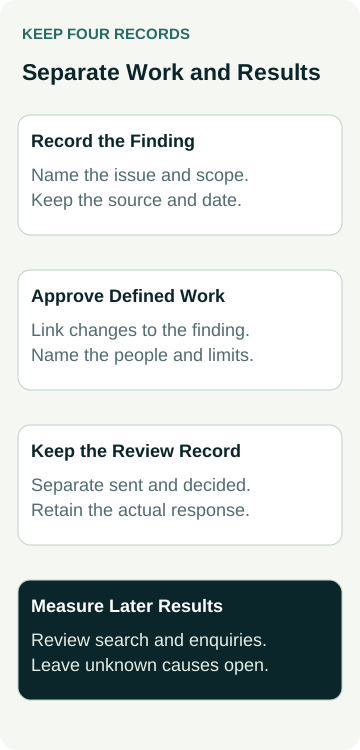
An Example: Two Different Recovery Quotes
An example home-maintenance business receives a recovery proposal after search clicks fall. The proposal assumes a manual action, but the owner has only seen a traffic chart and an automated audit score.
The owner asks for a bounded assessment first. Its job is to check the claimed finding and relevant alternatives, then explain the evidence. If there is no current manual-action notice, the next proposal should address the demonstrated problem rather than retain an unsupported manual-action label. This does not predict what the investigation will find.
Consider a second example business with a named issue visible in its Manual Actions report. Its quote lists “cleanup and reconsideration” but does not identify affected content or who will approve the changes. The owner asks for a change plan, implementation responsibility, checks and submission handover before accepting it.
These examples illustrate different commissioning decisions. Neither describes an AWE client, a completed repair or a measured recovery.
Check Readiness Before a Review Request
Google's guidance calls for addressing all listed issues before requesting review. Its reconsideration explanation places that request after the identified problems have been fixed. Ask the provider to show how its evidence supports that stage.
A useful handover should let you understand what changed, why it changed and what was checked on the live site. Keep a proposed action, completed implementation and submitted request separately identifiable. The SEO change-log guide can help you review that implementation record.
Agree appropriate Search Console access for the actual task. The person reviewing a proposal may need different access from the person later authorised to submit a request. Do not hand over passwords or grant ownership merely because a quote uses the word recovery.
Google advises waiting for the outstanding review decision rather than resubmitting while it is pending. Review time varies. Ask who will monitor the response, explain any remaining issue and obtain approval for further work. Avoid treating a submitted request as an accepted review.
Separate the Decision From Later Results
The closeout should distinguish the agreed changes, the review request and Google's recorded decision. Later search traffic and suitable enquiries need their own evidence. Agree a follow-up date, comparable reporting periods and which pages or queries matter to the business.
A lifted action does not, by itself, establish a return to an old position or a particular level of enquiries. Keep other website changes, seasonality and marketing activity visible when assessing what happened afterwards. Unknown causes should remain unknown.
To discuss the assessment your website needs, start with Australian Web Experts' SEO agency services. If you talk to Matt, bring the public website address, the issue described and the proposed work. Ask which assessment or specialist scope is appropriate before committing to recovery work.