

If two Google Business Profiles appear to represent your business, establish what each listing refers to before paying someone to merge or remove one. Similar names, a shared address or an unfamiliar account do not settle the question on their own. The useful first purchase is a clear assessment of the listings and the work each one needs.
For an Australian small-business owner, that assessment should connect public profile links with the real business, its location history and the access you already have. Approve a specific action for an identified profile, with the expected effect and remaining uncertainty explained. A promise to “clean up duplicates” is too vague to show which record would change.
Record the Listings Before Choosing a Fix
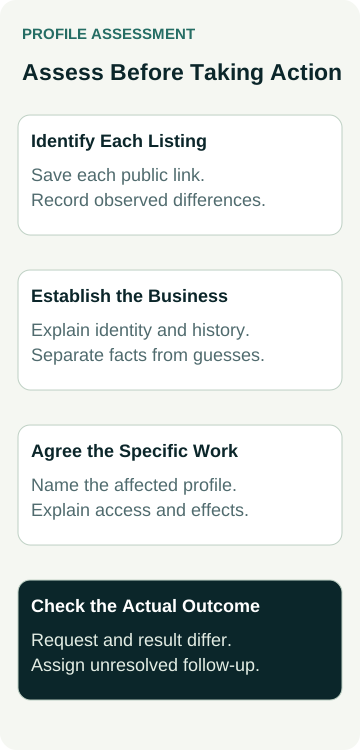
Give the provider a separate record for each apparent listing. Include its public Maps link, displayed name, address or service area, telephone number, website link and the date you observed it. Capture relevant differences without publishing customer information or sharing account credentials.
Explain what prompted the concern. Perhaps customers are seeing an old address, two results have different phone numbers, or someone told you that a profile is marked as a duplicate. Keep the observation separate from your explanation of its cause. “This result shows our former address” is more useful than assuming Google created a new profile when you moved.
Record what you know about management access as well. A public listing and an entry in a management account are different observations. Ask the provider to identify any uncertainty about the listing, account or status before proposing a change.
Avoid choosing a profile to keep simply because it has more reviews. The provider first needs to establish what the records represent and which action fits the circumstances. A review count does not explain the business history, eligibility or consequences of removing content.
Establish Whether They Represent the Same Business
Google's duplicate-profile guidance distinguishes duplicates from distinct eligible businesses sharing an address. It also treats ownership problems separately. The provider should explain which situation your evidence supports, rather than applying one cleanup procedure to every pair of listings.
Give the provider the real operating facts: whether the same business continues, whether both locations remain open and whether the names describe separate businesses or services of one business. If practitioners, departments or shared premises are involved, request a case-specific eligibility assessment.
Google's business representation guidelines call for accurate real-world identity, location and service information, with specific provisions for different business arrangements. Do not change those facts merely to make two records look alike. The proposed solution needs to fit the business that exists.
An old address needs context too. Our guide to moving your business and updating its address covers the wider customer changeover. Keep that relocation plan separate from the question of whether two profile records represent the same continuing business.
Separate Access Problems From Duplicate-Profile Work
A provider may need to investigate access before it can carry out an agreed change. Ask what access it needs, why it needs it and which person in your business will approve that arrangement. Keep passwords and recovery details out of the assessment brief.
Google's duplicate guidance describes requesting access where an existing verified profile is owned by someone else. Creating another record is not a substitute for establishing the appropriate ownership route. An agency should be able to explain whether it is assessing duplicate status, helping with access or proposing a different piece of work.
Ask how existing support cases will be handled. Supply relevant case references privately to the responsible person, and agree who keeps the working record. If the provider has not seen the current status or earlier correspondence, it should identify that gap before committing to a particular remedy.
An account invitation, ownership request and public Maps change each have their own purpose. Make the authorised scope clear. Paying for an assessment should not silently authorise every subsequent account or profile action.
Keep the observation, recommended action and Google outcome in separate fields. Finding two listings does not mean a merge has been approved or completed.
Ask for a Recommendation You Can Check
Use a small comparison record to make the proposed work understandable. The examples below identify questions for an assessment; they are not automatic instructions to change a profile.
| Observed Situation | Evidence to Clarify | Recommendation Must Explain |
|---|---|---|
| Two similar public listings | Each profile link and the real business behind it | Why the proposed action fits these particular records |
| Old and current addresses | What moved, what continues and which premises remain in use | How profile work relates to the customer changeover |
| Listing managed elsewhere | Known access, current status and relevant correspondence | Whether access work is needed before another action |
| Apparently distinct businesses | Actual names, operating arrangements and applicable eligibility | Why separate profiles or further investigation may be appropriate |
Request an explanation in familiar language. It should name the affected profile, describe the intended change, identify the person approving it and state what will be checked afterwards. Where the facts remain unclear, a recommendation to gather more evidence can be a useful assessment result.
Have the provider distinguish its deliverables from Google's decisions. The quote might include evidence collection, an assessment, preparation of an agreed request, follow-up and checks of the public result. Confirm which of those are included, what requires a further decision and how unresolved work will be handed back.
A Worked Example: Two Listings After a Workshop Move
An example repair business finds two Maps listings after moving its workshop. One has the former address and an old phone number. Another shows the current address. The owner asks for a price to remove whichever listing is wrong.
Before recommending that action, the provider is asked to identify both public profiles and confirm the business history. The owner explains that the same business moved, the former workshop no longer receives customers and no second branch remains open. The provider also needs to establish the current profile status and management access.
The owner requests a written recommendation naming the records, explaining the appropriate route under current Google guidance and identifying what could be affected. The work is not approved on the strength of a review-count comparison or an assumption that an old address always means an unwanted duplicate.
The assessment might leave questions about access or existing support correspondence unresolved. Those questions go into the scope record before the owner approves further action. This is an example buying decision, with no actual business, account access, request, merge or review transfer implied.
Agree the Limits and the Completion Evidence
Google says merge requests are reviewed. Where profiles are merged, reviews are combined, but review replies may be lost. Its guidance also warns that removing a mistakenly created duplicate removes its content and linked managers. Ask the provider to explain these consequences for the particular action it recommends.
Do not treat “request submitted” as “problem fixed”. Agree what the provider will record when it submits an authorised request, how it will check the outcome and when an unresolved case will be reviewed. A submission receipt is useful evidence of work performed; it is not evidence that the public result changed.
The closeout record should let you check:
- Which identified profile or profiles were involved and what was authorised.
- What action was performed, with an appropriate private reference where available.
- What the provider observed afterwards, including the date and remaining uncertainty.
- Who owns any unresolved access, information or support issue.
Keep a truthful distinction between the work completed and its commercial results. Correct profile information, visibility in a particular observation, customer enquiries and paid jobs are different outcomes. The provider should not promise a ranking increase or new business simply because a duplicate-related task is completed.
Bring the Assessment Into Your Local SEO Scope
Compare the recommendation with the problem you set out to solve. You should be able to identify the listings, understand the business facts and see why the proposed work fits them. If those pieces are missing, request the assessment before approving a merge, removal or broader account change.
Keep one responsible contact for the case and a clear record of the next decision. That gives your business something useful to review if the public information remains wrong or another provider later takes over the work.
Our local SEO services cover business information, local service pages, trust signals and measurement. Bring the profile links and known business history into that discussion so the appropriate assessment, authorised work and follow-up checks can be scoped around the actual issue.