

Agree where customers should go, from which date and under what visiting arrangements before changing public address information. Moving an existing business involves more than replacing a line on the contact page. The website, map links and Google Business Profile need a coordinated plan, with someone responsible for checking the public result.
Start with the business decision. Is the old premises closing while the same business moves, or will both locations continue? Are customers welcome at the new address, by appointment only, or not at all? Those facts determine what the public information should explain.
For an Australian small business, a useful relocation brief connects the real move with the work your website and profile providers will perform. It should identify the affected information, the approved changeover arrangements and how unresolved issues will be handled. It should not promise that rankings, verification or every third-party listing will behave in a particular way.
Keep the move record, proposed edits and public checks separate. Saving a new address in one system does not establish that every customer-facing destination is correct.
Confirm What Is Moving and When Customers Can Visit
Write down the old premises, the new premises and the business that is continuing. Distinguish a relocation from adding another branch, changing ownership or opening a different business. If the circumstances are mixed, have the responsible provider assess them before treating the work as a simple address update.
Confirm the last date customers can use the old location and the first date they can use the new one. Include the year in the working record. If there is a gap, say what happens to visits, collections, appointments and enquiries during that period. Do not advertise access to a premises before the business can receive customers there.
Identify which details are actually changing. The telephone number, service area, hours and services may stay the same, or some may change too. Record each confirmed change rather than assuming a new address means everything else needs rewriting.
If the move includes a short break, use the temporary-closure guide for that separate hours decision. Relocation concerns where the business operates; a closure notice concerns what customers can do during a particular period. The two records should agree without being confused.
Check Whether the Address Should Be Public
Google’s business-address guidance explains that the address shown on a Business Profile is public. It distinguishes businesses receiving customers at their premises from service-area businesses that can keep the address hidden and show their service area instead.
Confirm the actual customer arrangements before requesting a visible address or map. A workshop receiving agreed drop-offs is different from a business that travels to customers and does not receive them at its base. Moving an administrative office does not automatically create a customer destination.
Google’s representation guidelines call for an accurate real-world location and describe restrictions on virtual offices and co-working locations. Ask the profile owner to check the applicable requirements for the new premises. A rented mailing address is not, by itself, evidence of an eligible operating location.
Use the correct complete address, including relevant unit, floor or building information. Keep access instructions separate from the address itself. “Use the side entrance after arranging a collection” may be useful website wording, but it should describe the real arrangement rather than become extra wording stuffed into an address field.
Inventory the Places That Send Customers to You
List the public surfaces that currently show the address or direct someone to the premises. Start with the website contact and location information, shared header or footer content, embedded maps and directions links. Check relevant service pages and downloadable material if they contain visiting details.
A visible address and a map destination are separate checks. New text beside an old embedded map can still send someone to the wrong place. The website-map guide covers choosing the destination and explaining whether customers should visit.
Have the profile owner identify the correct existing business and location record before proposing changes. Flag any apparent duplicate or old-location record for review rather than creating extra profiles to work around uncertainty. Ask the provider to explain the appropriate treatment for this business’s circumstances using current guidance.
Then identify important external listings the business actually uses. Assign the relevant owner to review each one, with its account and permission requirements kept separate. A website edit cannot update every directory, social profile or third-party map automatically.
Keep unrelated account administration outside this list unless it has been expressly included. This article is a public location-information plan; registered-business details, leases, postal forwarding and other administrative obligations need their own responsible owners.
Agree One Relocation Record Across the Work
Give the website and profile providers the same approved facts. Ask each to state what it will change, what it will check and what depends on another owner or platform.
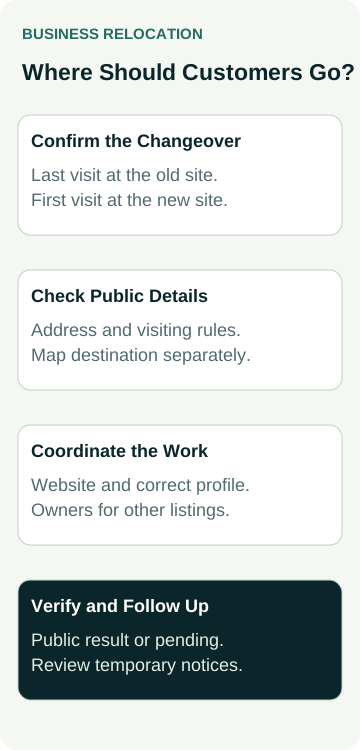
| Part of the Move | Facts to Agree | Check to Record |
|---|---|---|
| Customer changeover | Last old-location visit and first new-location visit | Public wording matches actual arrangements |
| Location details | Approved address, visiting rules and directions | Text and map destination are reviewed separately |
| Profile work | Correct business record and applicable requirements | Proposed, submitted and publicly visible states kept distinct |
| Follow-through | Remaining listings, notices and responsible owners | Open issues and next review date remain visible |
Do not approve a blanket instruction to replace every occurrence of the old suburb. An old project description or factual historical reference can have a different purpose from current visiting information. Have the website owner review the context and propose the smallest appropriate change.
Likewise, do not remove a service-area statement solely because the operating base moved. Confirm whether the business still serves that area. The new premises and the places where the team works are related facts, but they do not necessarily describe the same boundary.
A Worked Example: Moving a Repair Workshop
This is an illustrative relocation plan, not a client case or a ranking result. An example repair business is moving its workshop. It will stop receiving drop-offs at the old premises before starting agreed collections at the new one. Its telephone number remains unchanged, and customers must contact the business before visiting.
The owner confirms the actual dates and addresses in a private working brief. The website provider identifies the contact page, shared footer, map and collection instructions. The profile owner reviews the existing business record and whether the proposed location details fit the real customer arrangements.
The proposed website wording explains the changeover and appointment requirement. The map destination is checked independently of the address text. During the gap, customers are told which contact route remains available without being promised that a request is an accepted collection appointment.
After the authorised changes, the owners record what is publicly visible and what remains unresolved. If a platform update is pending, the record says so. The move is not declared complete merely because an edit was saved, and the plan does not predict search positions or customer visits.
Check the Public Result and Record Anything Pending
Agree a practical update and review sequence with the people doing the work. The correct timing depends on when the business actually changes premises and what the relevant platforms require. Avoid publishing future visiting arrangements as if they already apply.
Ask the profile owner what the current process requires, including any verification or pending-review issue. Google’s address guidance notes that profile changes can take time to appear. Do not build a customer promise around an assumed instant update or a guaranteed verification method.
Review the public website on desktop and phone. Can a customer find the current visiting instructions, see the relevant date and reach the intended map destination? Check both visible wording and links. Keep the review tied to the actual page version and conditions.
For the profile, distinguish the proposed edit, saved or submitted change and publicly visible result. Record the business identity checked, observation date and remaining issue. A screenshot of an editing screen is different evidence from the information a customer can see.
Reviewing a public map or link does not require travelling to the premises, placing a call or submitting an enquiry. Any real customer-route test should be agreed separately with the business. Keep private verification documents and account information out of public notices and evidence packs.
Close the Move Plan and Set the Next Review
Keep a short outstanding list until the agreed public information is checked. Name the owner and next action for any remaining directory update, map problem or pending profile change. A partially completed plan should not quietly become a claim that everything is current.
Agree when the temporary relocation message will be reviewed or removed. Once the move is established, the permanent contact information should explain the current arrangements without relying on an old announcement. Preserve useful change records privately.
- Business owner: confirms premises, dates, access and service arrangements.
- Website owner: updates the agreed pages and destinations, then checks the build.
- Profile owner: assesses the applicable record and requirements, performs authorised work and checks the public state.
- Listing owners: review the named external surfaces and report anything pending.
Australian Web Experts’ local SEO services are a starting point for discussing the search information affected by a move. Bring the proposed changeover and the places customers currently find your address. Agree the work and evidence needed for your business, rather than buying a promise that relocation will preserve every ranking or instantly update the web.