

Before approving a hreflang fix, ask which real pages are alternatives for which audiences. Record their language, intended country where relevant, and the customer information each version provides. A warning count alone does not explain what the business should change.
Hreflang is a search annotation used to describe language or regional versions of content. It can help Google understand those relationships. It does not translate a page, establish an overseas operation or guarantee which result a person will see.
For an Australian owner reviewing an SEO quote, the useful first deliverable is a readable list of page relationships. Ask the provider to separate correcting existing annotations from creating new content, changing URLs or expanding the business's market coverage. Those decisions can involve different people and costs.
Separate Language From Country
Google distinguishes a multilingual website, which uses more than one language, from a multi-regional website aimed at users in different countries. A site can do both. Two English pages may serve different countries; a translated Australian service page may still serve customers only within Australia.
In Google's localized-page guidance, the annotation begins with a language code and can include a country code. For example, en-AU identifies English for Australia and en-NZ English for New Zealand. A language-only value such as fr identifies French without specifying France. A country code on its own is insufficient.
Have the owner confirm the intended audience before the technical person selects the annotations. Neither a folder called “nz” nor an audit label proves that a business supplies New Zealand customers. Check the actual offer, delivery information and response arrangements with the people responsible.
If the job involves translation, our multilingual enquiry-scope guide covers wording review, forms and customer support. Keep that work explicit rather than assuming a technical SEO change includes it.
Ask for the Exact Page Pairs
Request one row for each proposed equivalent page set. Record the full public addresses, visible language, intended country if any, customer task, relevant differences and the person approving the business facts. Start with an important customer task before extending the record across the agreed scope.
Pair equivalent information. A delivery page in one region should not be treated as the alternative to an unrelated homepage simply because both belong to country folders. Where an equivalent is missing, mark the gap and ask for a proposed treatment. Do not invent a destination to complete a spreadsheet.
Separate three situations: existing alternatives with an annotation problem, a missing version the business actually needs, and an audit recommendation whose purpose has not been established. The first can need technical correction; the second also needs content and owner approval. The third needs explanation before a build is commissioned.
Approve the audience and page relationship first. Then ask for evidence that the website implements that agreed relationship.
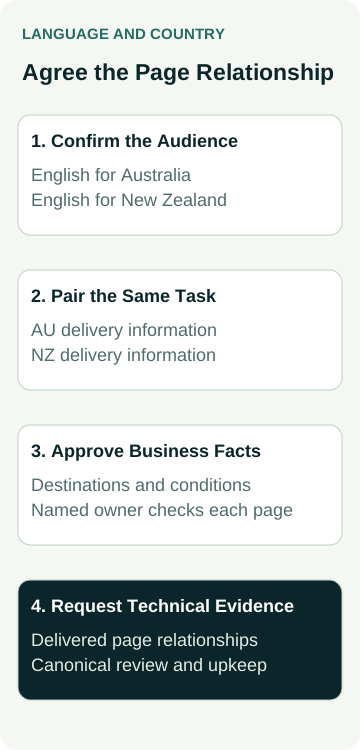
A Worked Example: Two English Delivery Pages
Imagine an Australian retailer that genuinely serves Australia and New Zealand. It has separate English delivery pages because the destinations, charges and delivery arrangements differ. This is an illustrative planning example, not an AWE client or a checked online store.
The owner and provider prepare this record. The paths are examples within a hypothetical site, not recommendations for changing an existing domain or URL structure.
| Review Item | Australian Version | New Zealand Version |
|---|---|---|
| Page and task | /au/delivery/ — understand Australian delivery | /nz/delivery/ — understand New Zealand delivery |
| Language and audience | English for Australia; proposed en-AU | English for New Zealand; proposed en-NZ |
| Business facts | Owner confirms Australian destinations, charges and conditions | Owner confirms New Zealand destinations, charges and conditions |
| Evidence still needed | Provider checks the agreed URL and delivered annotations | Provider checks the equivalent URL and reciprocal relationship |
Both pages are in English. Their regional purpose comes from the confirmed customer arrangements, not different language names. The owner corrects an outdated delivery condition before accepting the mapping. The provider records that content change separately from the annotation work.
A French-language page suggested by the audit is absent. Nobody has approved a French customer journey or its upkeep. The owner leaves that proposal unresolved rather than paying for an empty extra version. A future translation would need its own scope and language review.
The table is an approval record, not code, a complete annotation set or evidence that Google has processed anything. No order, delivery promise, search improvement or enquiry result has been tested in this example.
Keep Canonical Decisions in the Same Review
Ask how the proposed alternatives relate to the site's canonical preferences. Canonicalisation concerns which URL represents duplicate or very similar content; hreflang concerns language or regional alternatives. One label cannot substitute for a decision about the other.
Google's multi-regional website guidance discusses using canonical and hreflang signals together for similar or duplicate same-language regional content. Ask the specialist to explain the appropriate treatment for the actual pages. Avoid a blanket rule copied across every country folder.
Our canonical URL guide explains the distinction between the site's stated preference and Google's recorded selection. Keep both observations dated. An annotation report should not be presented as proof that Google has selected or shown the intended page.
Agree What the Technical Handover Will Show
Once the mapping is approved, ask the provider to name the implementation method and evidence for the agreed scope. Google supports HTML annotations, HTTP headers and sitemap entries. Its guidance requires versions to reference themselves and their alternatives, with reciprocal references between paired pages.
The handover should identify the checked URLs and explain any missing or incorrect relationships. Request the delivered output, not only a screenshot of a plugin setting. Include these questions in the scope:
- Do the destinations open the intended public information, including any redirects?
- Do the language and country values match the approved audience record?
- Are the relevant alternatives and return references present in the delivered setup?
- Have canonical preferences and access or indexing instructions been considered together?
For pages described as blocked or unindexed, use our indexing-evidence guide to separate the reported condition from an assumed cause. A hreflang correction is not evidence that another indexing issue has been resolved.
Also ask how visitors reach and switch between versions. Google's locale-adaptive guidance warns that content changing according to perceived location or language can leave variations uncrawled. Have the provider explain the actual arrangement rather than treating an automatic country switch as proof of discoverability.
Name the Owner of Later Changes
Record who updates the mapping when a page is renamed, withdrawn or added. The business owner remains responsible for accurate country-specific information; the technical owner needs to know when a page relationship changes. A translation reviewer may have a separate role.
Keep implementation checks, later Google observations and business outcomes separate. A completed correction can be documented without claiming a ranking lift. If a search result still looks wrong, retain the query, observed URL, country context and date for investigation rather than repeatedly changing settings from memory.
To discuss the issue, review AWE's SEO services or contact Australian Web Experts with the audit finding and relevant public URLs. Agree which page relationships, technical changes and follow-up checks are included before approving the work.