

Before approving a page merge, ask the provider to show which pages overlap, what problem customers face and what useful information the proposed destination will retain. Two pages mentioning the same service, or appearing for a shared search, are reasons to investigate. They do not establish that removing one will improve your website.
Keyword cannibalisation is an SEO industry term for pages on the same website competing for similar searches in a way that harms their performance. A report may use the label more loosely. Ask what the warning means in your particular case before buying the proposed repair.
For an Australian small-business owner, the decision has practical consequences. A page may explain different exclusions, preparation requirements or customer options even when its heading resembles another page. A useful review connects the search evidence with those differences and supplies a clear proposal you can approve.
Ask What the Warning Actually Shows
Start with the exact public addresses and the report's observation date. Open each page and read its main information and enquiry route. Check whether these are different pages, alternate addresses for the same content, or an old version that should already have been retired.
Ask the provider to separate the observation from the explanation. “Two pages appeared for this query” describes something recorded. “Those pages are reducing each other's performance” is a conclusion that needs more evidence. A change in the page shown for a query can have several explanations; a crossing line on a chart does not isolate the cause.
Agree which customer task is affected. Perhaps someone looking for a commercial repair reaches a page that only explains residential work. Perhaps two outdated service pages give conflicting preparation instructions. Those are concrete problems to examine alongside search visibility, even before anyone promises a ranking improvement.
If the issue is several addresses representing the same content, use our canonical-URL guide for that technical relationship. A content review should not silently turn different service offers into equivalent pages.
Compare the Customer Information on Both Pages
Put the pages beside each other and write down what a prospective customer can learn and do on each. Compare the actual offered work, suitable customers, exclusions, service coverage, preparation details and next step. Shared navigation and repeated contact details are less useful than the main explanation when deciding whether the pages serve different needs.
Ask the business person who handles enquiries to review the comparison. They may know that two similarly named services require different equipment, assessments or quoting inputs. That difference should remain understandable wherever the information eventually lives.
For a proposed merge, request a content transfer outline. It should identify what moves, what is rewritten, what is removed and why. Include useful photographs, downloads and specific answers, with their permissions and accuracy checked. “We will combine the content” leaves too much unresolved.
Keep a genuine offer change separate. If the business no longer provides a service, the owner needs to approve the updated customer message. A search warning does not authorise the provider to stop advertising work that the business still sells, or to invent a broader combined offer.
Read Search Evidence Within Its Limits
Ask for the query, page addresses, reporting period and filters behind the warning. Record the property, search type, country and device context. Compare like periods, and distinguish an exact query from a group of searches containing similar wording.
Our Search Console query-to-page guide explains how to keep reported pages separate from the destinations you want customers to reach. It is a starting point for this investigation, rather than proof that each query needs exactly one page.
Google's reporting limitations explain that some queries are omitted for privacy and that filtering can change the totals available. Page-level and property-level figures can also differ because of aggregation. An absent query row does not establish that a page has no useful audience.
Look at the pair's relevant searches and customer routes together. A quieter page might answer a specific question that helps someone choose the right service. Equally, two pages may repeat an unclear explanation. Ask what additional evidence supports the proposed action, and keep missing enquiry attribution marked as unknown.
Before approving consolidation, check that a customer can still find the information and next step they needed from either page.
Agree the Treatment and What Must Be Preserved
A provider may recommend keeping both pages, clarifying their roles, combining their useful information or correcting alternate URLs. Request a reason that matches the actual content and evidence. A tidy page count is not a business outcome.
Use a short decision record when assessing the scope:
| Finding to Review | Proposed Treatment to Assess | Evidence Before Approval |
|---|---|---|
| Different customer tasks with useful distinct information | Keep both and clarify their roles | Revised outlines and a clear route between related information |
| Same task with repeated or conflicting explanations | Consider one combined destination | Transfer outline preserving necessary details and an approved customer route |
| Alternate addresses for substantially the same content | Review the representative URL and technical handling | Exact address relationship and intended behaviour |
| Unclear overlap or too little reliable evidence | Hold the removal decision and investigate | Named missing evidence, responsible person and next review |
These are options to assess, not instructions to change your site. A review can reasonably end with no merge when the pages have separate, useful purposes.
Google's canonical guidance concerns duplicate or very similar content. It describes redirects and canonical links as strong preference signals, while Google makes the selection. A canonical link does not move a visitor. Ask the technical owner to explain the chosen behaviour rather than treating every overlap as a canonical-tag problem.
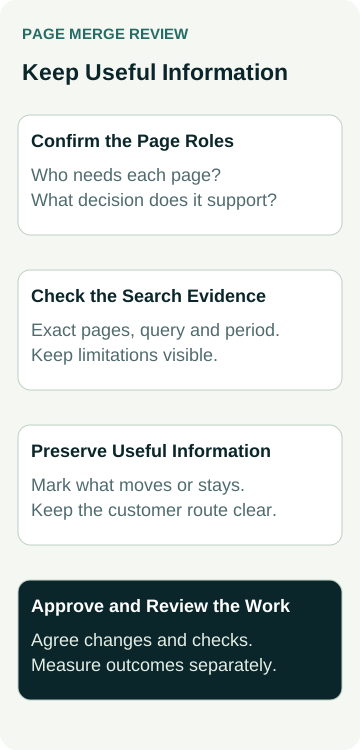
A Worked Example: Two Equipment-Hire Pages
An example equipment-hire business has a page for hiring a carpet cleaner and another explaining carpet-cleaner collection and use. Both mention carpet-cleaner hire. An SEO report flags shared searches and proposes merging them.
The owner reads both pages with the person who handles bookings. The hire page explains the equipment offered and how to request availability. The preparation page explains collection requirements, suitable use and what customers should bring. Those details affect whether someone can complete the hire successfully.
The provider is asked to compare two proposals. One keeps the preparation page with clearer links from the hire route. The other incorporates the necessary preparation information into the hire page, with readable sections and a clearly accessible download where appropriate.
Before choosing, the owner requests a marked outline showing where every necessary instruction would remain. The website person checks existing booking links and document references, so the change does not strand someone using an older instruction sheet. Unclear search evidence is recorded as a limitation of the recommendation.
The owner can then approve a specific content and website scope, or retain both pages. This example describes a review decision only. No pages have been merged, and no search improvement, booking increase or customer result has been measured.
Ask What Implementation and Follow-Up Cover
If a merge is approved, agree who handles the content, website changes and subsequent review. Request a list of affected addresses and dependencies before implementation. Existing internal links, menus, downloads, campaign destinations and external references may need attention, depending on the actual site.
Ask the quote to distinguish:
- The content transfer and business accuracy review.
- Any redirect or canonical work appropriate to the agreed treatment.
- Checks that the intended page, useful details and enquiry route work after the change.
- Later search observation and reporting, with its limits stated.
The website owner should retain a recoverable version and a record of the approved changes. Agree how a missing instruction, broken route or incorrect service statement will be corrected. This gives you a practical handover even while later search processing remains uncertain.
Review the Customer Route and Business Outcome
At handover, inspect the actual delivered page and follow the routes affected by the change, including on a phone. Confirm that the approved information survived and that old addresses behave as agreed. Completion of those checks is separate from a later change in search visibility.
For the search review, use comparable reporting settings and consider the relevant page pair's history. Keep other edits, seasonal demand and reporting limitations visible. A rise after a merge does not by itself establish that the merge caused it.
Review suitable enquiries and their outcomes separately from clicks. If you want help assessing the warning within a campaign, explore AWE's SEO services. Bring the page addresses, the report settings and the customer information each page needs to preserve so the proposed work can be scoped clearly.