

Before buying local SEO for a second location, ask the provider to separate work shared across the business, work specific to the new branch and ongoing work at the existing branch. Then agree who supplies the facts, who completes each task and what must be checked before customers start arriving.
A second location can add profile, website, listing and enquiry-handling work. It does not tell you, by itself, that you need a second website, a duplicate campaign or the same package charged twice. Compare the actual tasks and responsibilities.
Start with the operating arrangement. A new customer-facing branch, a wider service area and a move from one address to another need different plans.
Give the provider the real branch arrangements and the work already covered by your current agreement. Ask for a proposal that explains what changes, what continues and what remains unresolved.
Confirm What Is Opening
Write down the new location's purpose, services, customer-facing arrangements and expected opening date. Who will work there? Can customers visit? Will it have different hours or a different way to book? Which details are confirmed and which depend on fit-out, staffing or other preparations?
Treat those questions as business decisions before turning them into public search information. Someone responsible for the branch should approve the facts supplied to the SEO provider.
Use this comparison to describe the change:
| Business Change | What the Provider Needs to Establish | Scope to Discuss |
|---|---|---|
| Additional customer-facing branch | Its real operating arrangements, profile eligibility and the information customers need to visit or contact it. | New-branch preparation alongside continuing work for the existing location. |
| Wider service coverage | Where the business can genuinely fulfil work; whether there is any additional operating location. | Accurate coverage and enquiry information, without treating every served suburb as a branch. |
| Relocation of the existing business | What is moving, what closes or continues, and which existing information needs updating. | A coordinated change to the existing presence, with dependencies and customer directions checked. |
Google's business representation guidelines require accurate real-world information. A rented mailing address where the business does not operate is ineligible for a profile. A co-working office must meet its stated signage, staffing and customer-reception conditions.
Service businesses with different locations, separate service areas and separate staff may have a profile for each location under Google's rules. Merely serving another suburb does not establish that arrangement. Ask the provider to explain the applicable eligibility before creating anything.
Separate Shared Work From Branch Work
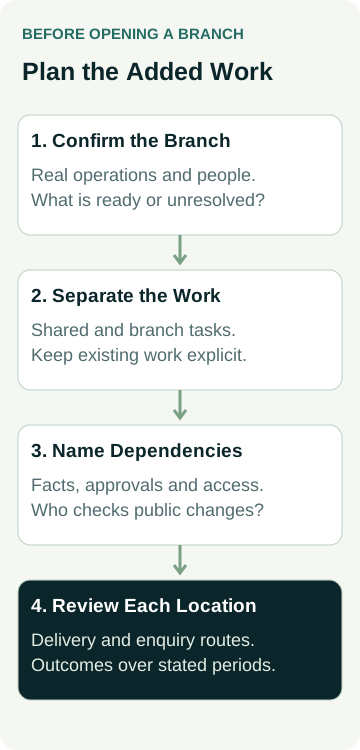
Ask for one coordinated scope that shows which tasks benefit the whole business and which need separate attention. The purpose is to make the added work visible, rather than assume every item doubles.
Shared work might include reviewing the website's structure, maintaining general service information and agreeing how enquiries are recorded. Branch work might include checking local business facts, preparing location information, managing an eligible profile and reviewing relevant existing listings. The provider should explain which of those tasks your actual plan needs.
Confirm how the current location will be supported during the new work. If the same budget is being redistributed, which tasks are delayed or reduced? If extra work is quoted, what additional deliverables and continuing responsibilities does it buy?
Ask the proposal to distinguish initial preparation from ongoing activity. Profile setup, writing and website implementation can involve different people from later reporting, information updates and customer-review responses. An opening project should not leave those later responsibilities unassigned.
Compare fees on the same tax basis and over the same stated period. Clarify excluded website development, photography, copy approval, tools or outside listing charges. Do not assume a current package covers them, or that every possible task is necessary for your branch.
The current SEO packages provide a starting point for discussing scope. A provider still needs to explain how its proposal fits your existing and new locations.
Give Each Branch a Clear Customer Journey
A customer should be able to tell which location offers the service, when it is available and how to reach the right person. Give the provider the information needed to build that journey.
Useful inputs include the approved address or service arrangement, opening information, available services, contact routing and practical visiting details you can substantiate. Supply actual photos when available and authorised for use. Hold anything that is still a plan instead of presenting it as already operating.
Ask the website owner and SEO provider to agree where branch information belongs and how it connects to existing service and contact pages. If a separate branch page is proposed, identify its customer purpose and the facts it will contain. You do not need a second domain simply because there is a second address.
Our guide to deciding when a service needs its own page covers a related content decision. For a branch opening, the immediate requirement is that the location, available work and contact route are clear together. Keep the page plan proportionate to that need.
Test the enquiry routing before announcing the location. If both branches use one phone number or form, agree how staff identify the intended location and who responds. If there are separate contact paths, confirm that each reaches the right team. A website button working visually does not establish that a request reaches the intended recipient.
Agree the Opening Dependencies
Put the tasks in an order that reflects the actual opening. Which facts must be confirmed before writing? Who approves them? Who can implement the website changes? Who handles any Google verification requirements? Which public checks are needed before the announcement?
Google has a future opening-date feature for businesses that have not opened. Its help says that after you enter the date and verify your business, the profile can appear 90 days before opening. Use the documented process and the real date. Do not assume preparing a profile means it is verified or publicly visible.
The provider should record dependencies that it cannot resolve alone. Missing signage, unfinished contact arrangements or an unconfirmed service list need a responsible person in the business. A platform review or verification step needs its actual status recorded, rather than a guaranteed completion date.
Agree who can authorise public changes. Keep the existing branch's address and contact information in place when it remains open; the new branch should not silently replace it across the whole website.
A Worked Example: One Showroom Stays Open
An example flooring business plans a second showroom while keeping its first showroom open. Both sell the same broad range, but the new location has different opening hours and a different team. Phone enquiries will initially go to one central staff member.
The first SEO proposal says “add a location” without showing whether the existing campaign continues. The owner asks for a clearer breakdown.
The revised proposal separates shared website work, preparation for the new showroom and continuing checks at the first showroom. The owner supplies the confirmed branch facts and nominates a manager to approve them. The website owner is responsible for implementing approved branch information and checking navigation and contact routing. The profile manager assesses eligibility and handles the appropriate opening and verification process.
The central staff member needs a way to identify which showroom the caller intends to visit. The website contact instructions and staff process are reviewed together. A form test is checked with the actual recipient before the announcement; any unresolved delivery issue stays on the opening list.
When the fit-out changes the planned opening date, the manager informs the people responsible for the website and profile. They review the affected information instead of leaving two different dates public.
The owner approves the extra work once its tasks, costs and continuing responsibilities are clear. This example illustrates coordination. It does not claim that either branch gained rankings, received enquiries or made sales.
Review Each Location Without Losing the Whole Picture
Ask for a baseline that distinguishes the established branch from the new one. Record the date each branch becomes operational, what was implemented and any measurement gaps. A new location does not have the same history as an established location.
Google says local ranking depends mainly on relevance, distance and prominence. It also says there is no way to request or pay for a better local ranking. Opening a branch or completing a profile does not guarantee a position in Maps.
Agree a practical review sequence:
- Confirm the public branch information matches the approved facts.
- Check the profile's actual status and the relevant website and contact routes.
- Record search and profile observations separately for each location where the tools support them.
- Review suitable received enquiries and completed business outcomes alongside those observations.
- Decide what to continue, clarify or change in the next stage of work.
Keep the business-wide picture as well. A central enquiry team may handle work for both branches, and a customer may visit one after discovering the other. Explain how location is assigned in the record and leave it unknown when it cannot be established.
A monthly SEO report can show the wider campaign context. Ask it to distinguish work completed, visibility observations and business outcomes. More total traffic alone will not tell you whether the new branch is attracting the work you wanted.
Discuss the Additional Scope Before Committing
Bring your current agreement, website, existing profile and confirmed branch arrangements to the discussion. Explain which people in the business can supply facts, approve content and handle enquiries.
Australian Web Experts' local SEO service covers business-profile information, local service pages, listings, technical work and measurement around genuine operations. Use those areas to discuss the work your expansion needs, without assuming a standard second-location package.
Get in touch with Australian Web Experts to discuss the additional scope. Agree what is shared, what is specific to the new branch and how both locations will be supported after opening.