

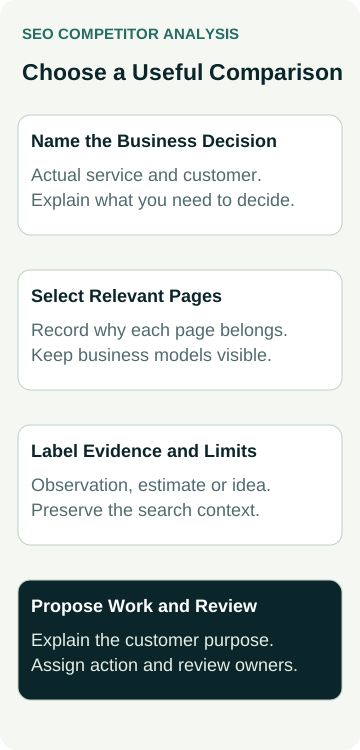
Before paying for SEO competitor analysis, ask why each business, page and search belongs in the comparison. A report can contain accurate observations about websites that have little to do with the work you want to win. Agree the buying question before treating every difference as a gap to close.
For an Australian small service business, that question might concern a service you already provide, an area where you accept work or a customer question your website handles poorly. The analysis should help you decide what to investigate or improve, with evidence and limits you can understand.
You can suggest businesses customers mention when comparing quotes. The SEO provider should also explain which other websites appear for the relevant searches. Those lists may overlap, but they answer different questions. A directory, supplier or information publisher can appear alongside businesses that compete for the same jobs.
Start With the Business Decision
Tell the provider which service matters and what a suitable customer needs. Describe the work you accept, the area you serve and the important exclusions. A repair business that services appliances in customers' homes needs a different comparison from a retailer selling replacement parts nationally.
State what the analysis should help you decide. You might want to assess whether an existing service page explains the job clearly, understand which kinds of results appear for a relevant query or choose a sensible first stage of an SEO campaign.
Ask how that decision connects with the proposed work. “Our competitors have more pages” leaves the purpose unresolved. “Customers need to know which appliance types we repair, and our current page does not explain that” describes a business information problem worth checking.
Keep a new service or location separate from an observation about another company. A competitor advertising elsewhere does not establish that your team can serve that area. The owner should approve the business scope before the provider recommends content or public claims about it.
Explain Why Each Comparison Belongs
Ask for the exact website or page and a short reason for including it. Check the actual service, customer type and operating model rather than relying on a similar business name or a high-looking tool score.
Use a comparison record like this when reviewing the proposed scope:
| Result or Business | Why It Might Belong | Limit to Clarify |
|---|---|---|
| Business offering a similar service in the relevant area | Helps compare the explanation and customer route for that work | Confirm the service and customer fit before calling it a direct rival |
| National company with many services | A particular page may address the same customer task | Whole-website totals may include unrelated services and locations |
| Directory or marketplace | Shows another route appearing in the search results | Its business model and page structure differ from a service provider's |
| Guide, supplier or parts retailer | May help explain what the search is asking for | It may serve an information or product need rather than the job you sell |
A mixed result can still teach you something. It may prompt a discussion about search intent or how customers choose a supplier. Ask the provider to explain that lesson rather than exclude inconvenient results or treat every listed website as an equivalent competitor.
Be clear about what is being compared. One relevant service page can be useful even when the wider company is very different. Conversely, comparing entire domains can obscure the specific page and customer task that matter to your decision.
Keep the Search and Page Context
Have the provider record the query, observation date, result type and available location, language and device context. A sponsored listing, a local business result and an ordinary website result should remain identifiable in the analysis.
Google explains that search results can differ with time, context and personalisation. Location, language and device type are among the contextual factors it describes. A screenshot is therefore an observation under particular conditions, rather than proof of one permanent order for all customers.
If the comparison includes Maps or local positions, use our guide to agreeing search locations in a local rank report. That guide covers the measurement plan. Here, the buying decision is which businesses and pages make a useful comparison for the analysis.
Ask the provider to open the destination page and explain what it offers. A search title or short extract may leave out service limits or lead to a broad homepage. Keep the page address with the observation so you can review the same material later.
Treat an AI answer as a separate observation if it is included. Record the actual question, platform and date, then distinguish a business mention, a recommendation and a linked source. One answer should not silently become a claim about every AI service or a national market position.
Separate Public Observations From Estimates
Public pages can show how a business describes a service, presents examples and guides a visitor towards contact. They do not, by themselves, establish that business's actual enquiries, accepted jobs, profit or reason for ranking.
Ask the supplier to label third-party traffic figures, keyword volumes and other modelled measures as estimates where that is what they are. Request the tool, reporting period, country setting and any important coverage limits. A precise number still needs an explanation of how it was obtained.
Keep three things visible: the observation, the provider's interpretation and the proposed action. Seeing a competitor's detailed service page supports an observation about its content. It does not prove that copying its length, layout or wording will produce the same results.
Google's people-first content guidance asks whether material offers original value and avoids simply copying or rewriting other sources. Use competitor research to identify questions your business can answer from its own knowledge and approved evidence. Another company's projects, credentials and promises cannot supply those facts for you.
If the proposal turns estimated competitor traffic into an enquiry forecast for your business, check the forecast's assumptions. Keep the estimated opportunity separate from observed customer demand and your own conversion evidence.
A Worked Example: Comparing a Repair Service
An example appliance-repair business wants to discuss SEO for dishwasher repairs within its genuine service area. The owner knows two businesses customers have mentioned, and asks the provider to explain the proposed search comparison before accepting the analysis.
The comparison plan includes a relevant repair-service page, a national parts retailer and a directory. The service page can help assess how another provider explains eligibility and the next step. The parts retailer may address buying a component; the directory offers a way to find businesses. They are retained with different purposes rather than combined into one list of identical rivals.
The owner notices that their own page leaves the supported appliance types unclear. They confirm the actual service limits and ask whether improving that explanation should be considered. The recommendation would need to identify the affected page, approved facts, implementation work and review measure.
The example ends with a proposed comparison and a question to investigate. No real search positions, competitor traffic, customer counts or campaign results have been measured here. No other business's wording, service claims or projects have been adopted.
Turn Findings Into Proposed Work
Ask which findings matter to the decision you agreed at the start. A useful recommendation should identify the evidence, explain the customer relevance and say what further information is needed. It should also distinguish a website problem you can demonstrate from a hypothesis worth testing.
For each proposed change, name the page or task, the person who supplies the facts and the person who implements it. Clarify dependencies, approval and completion checks. An analysis fee does not automatically include writing new pages, developer work or ongoing reporting.
Keep the comparison evidence beside the recommendation, including the reason a result was included and what it cannot establish.
Do not let a competitor's larger page count or link total become a purchase target on its own. Ask what the proposed work will help a suitable customer understand or do, and why that work belongs on your website.
Agree the Deliverable and the Review
Before committing, confirm the services and searches covered, how comparison pages will be chosen, which data sources will be used and what explanation or discussion you will receive. Ask how missing information, changing results and additional work are handled.
Keep the original comparison and its observation context. If it is repeated later, record changes to the query set, pages or method so the review can distinguish a changed comparison from evidence of progress.
Review publication, search visibility, relevant visits, qualified enquiries and paid jobs separately. Completing the analysis establishes a deliverable; its commercial value needs later evidence about the decisions and work that followed.
To discuss competitor research within AWE's SEO services, bring your website, priority service, actual operating area and the businesses customers compare you with. Ask how the proposed analysis would inform the work, and agree its scope, costs and review responsibilities before proceeding.