

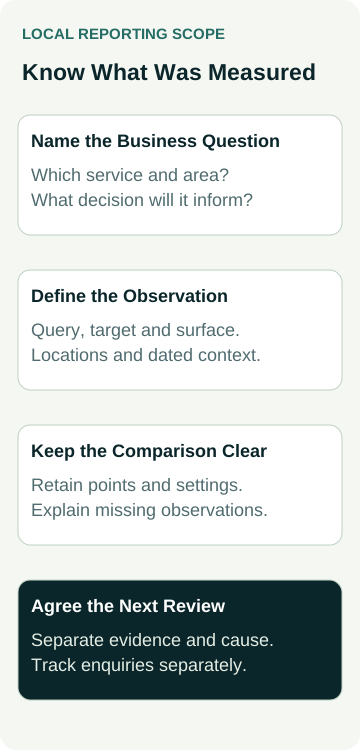
Before paying for a local rank-tracking report, agree what will be searched, which result type will be measured and which locations the observations will represent. A headline such as “you rank fourth” leaves too much unexplained if your customers search from different parts of the area you serve.
For an Australian small business, a useful report connects those observations with a real business question. You might want to understand visibility near an existing premises or compare selected parts of your service area. Approve the measurement scope before judging the colours or positions, then keep that scope with each report.
Start With the Decision the Report Should Support
Tell the provider what you want to learn. “How does our profile appear for this service across these customer areas?” is a clearer brief than “show our Google ranking”. It identifies a question that a local observation plan can address without suggesting the report measures every possible search.
Choose services your business actually offers and areas where it can accept suitable work. Explain whether customers visit a premises, the team travels to them, or both. Those facts help the provider propose a relevant measurement area; they do not establish where you will rank.
Google's local-ranking guidance identifies distance as one of the factors in local results. It describes distance in relation to the customer searching. That makes the observation location relevant to interpreting a local position, alongside the other conditions of the search.
Ask how the proposed reporting will inform a decision. It might identify an area to investigate or help review an existing local-search campaign. A report should not automatically trigger new suburb pages, profile changes or additional spending without a separate explanation of the evidence and proposed work.
Name the Query, Business and Result Type
Record the exact search phrase, including any place name in it. A generic service query and a query that names a suburb ask different things. Keep brand searches distinct from searches for the services your business wants to be considered for.
Then identify what the tool will report. Ask whether the observation concerns Google Maps, a local result section in Search, ordinary website results or another surface. Do not treat those positions as interchangeable because they appear under the same keyword heading.
Specify the business profile or website being tracked. A shortened business name in a dashboard may be insufficient where there are similar names, several genuine locations or an old record. The provider should be able to identify the intended listing or destination before collecting observations.
Ask which other conditions the tool controls or records, such as language, device context and collection time. If it cannot expose a setting, note that limit. You need an understandable description of the measurement, not a claim that a tool recreates every customer's experience.
Choose Locations That Match Your Business Question
Have the provider show the proposed observation points and explain their extent and spacing. A grid is a set of selected locations used for the checks. It is not a record of actual people searching or evidence that every household within its outline saw the same result.
Review the area against your business purpose. A neat square centred on an address might include places that do not matter to the decision, while missing somewhere you want to understand. Ask why each group of points belongs and whether the proposed area fits the question you agreed.
Google's search-location guidance explains that location can affect results even when a search does not include a place name. It also describes several sources Google may use to estimate location. A casual check from the owner's device therefore needs its own context; it is not automatically a matching observation for a provider's report.
Keep measurement points separate from business locations. Checking visibility from another suburb does not establish that you operate an office there or justify advertising an address you do not use. Choose the observation plan around genuine customer and service arrangements.
Ask what each point represents, which result was checked and when. A coloured map is useful only when its labels and limits can be explained.
Put the Reporting Scope Beside the Results
Use a short scope record when comparing a provider's proposal or reviewing its sample report. The table below describes information to request; it is not a required grid size or a claim about features in a particular tool.
| Scope Item | Evidence to Request | Comparison Question |
|---|---|---|
| Business and query | Exact profile or website and search phrase | Are both reports observing the same target and question? |
| Result and context | Search surface, recorded settings and collection time | Are the positions defined in the same way? |
| Locations | Point list or map, extent and spacing | Has the observation area or set of points changed? |
| Missing results and summary | Collection limits, unavailable checks and calculation method | Does the summary include comparable observations? |
Ask the supplier to explain any label for a business that was not found in the checked results. The collection may have a defined limit. A failed check, an unavailable observation and a position beyond that limit need clear meanings; they should not quietly become the same number.
If the report shows an average, percentage or visibility score, ask how it is calculated and which observations it includes. Keep the definition with the report. A summary can change when the set of locations or queries changes, even when it does not demonstrate improvement in the previously measured searches.
A Worked Example: Reviewing a Mobile Repair Service's Area
An example mobile repair business wants to understand local visibility in the areas where it accepts work. Its owner receives a proposal for a monthly map report centred on the business base.
The owner asks the provider to show the planned points before agreeing to the report. Some proposed observations concern areas outside the work the team wants to assess, while another relevant customer area is missing. They review the selection against the actual service arrangements and record the reason for the chosen area.
They also agree the exact service query, intended profile and reported result type. The owner asks how the provider will label unavailable checks and explain the summary. Future changes to the query or point set must be recorded so the owner can understand which comparisons remain valid.
This example sets out a buying decision. It contains no actual business scan, measured positions, customer search counts, performance change or recommendation to alter a public profile.
Keep Repeat Observations Comparable
Retain the original report and its settings before changing the measurement plan. When reviewing two runs, check the query, target, result type, location points, timing and available context. If something changed, explain the effect on the comparison rather than presenting every difference as campaign progress.
Ask the provider to show the underlying observations where a summary is surprising. A small set of selected points cannot establish one permanent ranking for a whole suburb or city. Treat the report as evidence collected under stated conditions and decide whether further investigation is useful.
Keep other data sources clear too. If your review includes Search Console, check its property and reporting scope separately. Do not expect a third-party local observation and a different report's aggregate to describe the same measurement simply because both concern Google visibility.
Agree the reporting frequency around the decision and the work being reviewed. Confirm what the quote includes, such as setup, repeat collection, interpretation, changes to the plan and follow-up on unavailable checks. A larger grid or more frequent scans should have an explained purpose and cost, rather than being assumed necessary for every business.
Ask for an Interpretation Before Approving More Work
The provider's explanation should distinguish what was observed from what it thinks caused the result. A weak position at a selected point does not, by itself, prove that your website needs another page, your business needs more reviews or a particular competitor caused the change.
Before agreeing to further work, ask for:
- The observation that prompted the recommendation and its measurement scope.
- The business relevance of that query and area.
- The proposed action, its owner and any evidence still needed.
- A clear follow-up measure that matches the question being investigated.
Track commercial outcomes separately. A better observed position is not proof that suitable customers enquired or accepted a quote. If search clicks rose without more enquiries, review the query mix and enquiry evidence rather than assuming another ranking change will resolve it.
Our local SEO services cover business information, local service pages, trust signals and measurement. Bring the sample report, measurement scope and actual service area into that discussion so the reporting and proposed work can be assessed against what your business needs to learn.