

Before relying on an SEO traffic or enquiry forecast, ask which numbers were observed, which were estimated and which are still unknown. Then ask what the forecast actually counts: total traffic, additional traffic, received enquiries or suitable new-business requests. Those are different outcomes.
A forecast can help you discuss priorities and expectations. It becomes useful when you can trace the inputs and see what happens if an assumption changes. Keep the forecast beside its assumptions, rather than approving a campaign from the final chart alone.
Name the Outcome and the Comparison
Start with the sentence the proposal is making. “More traffic” needs a channel, a measure and a period. “Twenty leads” needs a definition of a lead and an explanation of how that figure was calculated. Ask the provider to write these details in ordinary language.
Confirm whether the number is a total or an increase over an agreed baseline. A model that shows 500 monthly organic visits is different from a model that shows 500 additional visits. If the current baseline already contains visits the model is counting, treating the whole forecast as new growth would overstate the difference.
Check what is included in that baseline. Brand searches, existing-customer support and searches for services you do not offer may need separate treatment. Do not assume every visit is a new customer opportunity. Our query-mix guide explains how to inspect the relevance of observed search traffic; use that evidence to question the model’s starting point.
Keep the comparison periods and reporting settings with the forecast. A seasonal business needs a sensible comparison with its trading cycle. A recent tracking change can also make old and new figures difficult to compare. If the baseline is incomplete, record the gap instead of quietly presenting an estimate as measured history.
Separate Measured Inputs From Modelled Ones
Ask for a short input record. It should identify the source, date range, geography, definition and any adjustment for each important number. An exported report and a provider’s judgement can both inform a discussion, but they need different labels.
For an Australian service business, check whether the proposed searches match the services and areas you actually cover. A national estimate may not describe the opportunity for a business accepting work in a smaller area. Also ask whether similar terms overlap before someone adds them into one opportunity total.
Google’s Keyword Planner forecast guidance distinguishes historical search metrics from advertising forecasts. It says forecast impressions account for factors such as bids, budgets, seasonality and historical ad quality. Its forecast clicks describe clicks an ad might receive. Those figures are not a direct prediction of your future organic website visits.
The same guidance describes average monthly searches using the selected time range, location and Search Network settings, and says search-volume statistics are rounded. If a proposal uses these figures, ask which settings were used and how the provider moved from search estimates to an organic traffic scenario. The tool’s name alone does not explain that step.
Ask for the Input Record Before the Headline Number
Use this compact record to review the proposal. You do not need access to every tool to ask what an input means. Where a provider cannot support a value, leave it unknown or clearly label it as a planning assumption.
| Forecast Element | Evidence to Ask For | Point to Clarify |
|---|---|---|
| Starting traffic | Named report, completed period and channel or filter settings | Is this a measured baseline, and does the forecast show total or additional traffic? |
| Future visits | Relevant services, market settings and the model’s explanation | Which ranking, click-share or growth assumptions produce this number? |
| Enquiry estimate | Defined enquiry stage and a suitable source for the assumed rate | Does the rate describe genuine received enquiries, events or something else? |
| Delivery and review | Planned work, dependencies, timing assumptions and review owner | What could delay the work, and when will assumptions be reconsidered? |
Ask the provider to identify borrowed assumptions. A rate from another business or a broad industry average might be used to explore a scenario, but it should not be presented as your measured performance. A precise-looking decimal does not repair a weak input.
Agree how the forecast handles missing information. A new website may have little usable history. That makes an assumption-based discussion possible, while limiting the strength of the conclusion. It is reasonable to ask for a bounded first stage of work and a later review rather than a confident sales total.
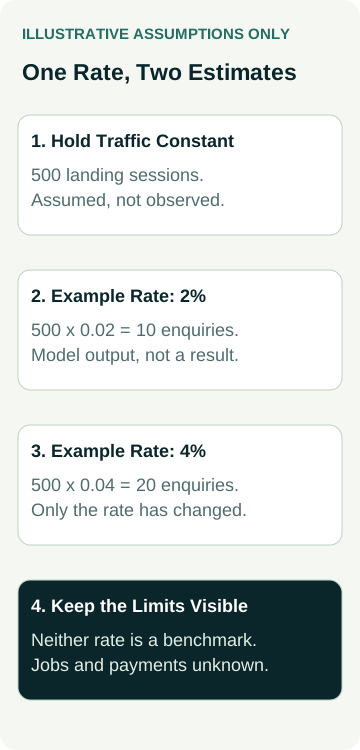
A Worked Example: One Assumption Changes the Enquiry Estimate
Illustrative example: an equipment-servicing business receives a proposal using 500 organic landing sessions in one future month. The model assumes that 2% of those sessions will result in a genuine new-business enquiry. The arithmetic is 500 × 0.02 = 10 estimated enquiries.
Keep the session figure unchanged and replace the enquiry-rate assumption with 4%. The arithmetic becomes 500 × 0.04 = 20 estimated enquiries. The doubled output comes entirely from the changed rate. It does not establish that the website will attract more visitors or that either rate is realistic.
Both the 500 sessions and the two rates are invented for this example. They are not Australian benchmarks, client results or a recommended forecast. The enquiry count is the model’s output under each assumption, not a statistical confidence interval or a promised range of future results.
The owner asks where the 2% rate came from, what counts as an enquiry and whether the source data relates to comparable pages and traffic. If that evidence is unavailable, the input remains an assumption. The next useful step is to improve the evidence or discuss the decision under that uncertainty.
Neither estimate tells the owner how many requests will fit the offered service, become accepted jobs or be paid. The enquiry-to-outcome log keeps those stages separate. Do not turn an enquiry estimate into booked work by silently treating every request as a sale.
Check the Planned Work and the Timing
A forecast should explain what work it assumes will happen. New content, technical corrections and changes to the enquiry path may depend on business information, approvals or implementation. Ask who supplies those inputs and whether the delivery plan matches the assumptions in the model.
If the projection assumes that every change is live immediately, ask how the early periods were modelled. A planned page is not a published page, and a published page is not proof that search traffic has changed. Keep delivery milestones separate from later observations.
Google’s guidance on hiring an SEO encourages asking about expected results, timeframes and how success will be measured. It says an audit should provide realistic improvement estimates and an estimate of the work involved. It also warns that nobody can guarantee a number-one ranking.
Ask which conditions would make the provider revise the forecast. Preserve the original version so later changes to assumptions remain visible.
Discuss slower progress, implementation delays and weaker enquiry rates as well as the preferred case. Changing one input at a time helps you see which assumptions drive the output. Where several inputs are changed together, ask the provider to explain their combined effect rather than presenting a wider band as proven accuracy.
Agree How Forecast and Actual Results Will Be Compared
Give the forecast a version, a date and a named review owner. Keep the original source periods and definitions with it. At review time, compare the agreed measure with the observed result for a completed period, noting any changes to the website, tracking, offer or operating conditions.
Record the work that actually went live using a clear SEO change log. That gives the review a delivery record. It does not by itself show which change caused an increase or decrease in traffic or enquiries.
If the result differs from the forecast, identify the input or dependency to examine. Was the work delayed? Was the baseline wrong? Did the assumed enquiry rate lack evidence? Keep “not yet known” available when the data cannot answer the question.
A review should not replace the old projection and then claim the new version was the original expectation. Preserve both versions, the reason for the revision and the next review point. That makes the forecast useful as a decision record even when the first estimate proves unsuitable.
Take the Assumptions Into the Proposal Discussion
Ask for the outcome definition, baseline, input record, planned work and review process together. A forecast is one part of assessing a proposal. Also check the actual scope, responsibilities and terms rather than treating the model as a substitute for them.
If you are discussing SEO services, bring your current reporting and the questions you need answered. Contact Australian Web Experts to agree the SEO work and reporting scope. Any forecasting work, data preparation or ongoing review needs its own agreed scope and evidence; an illustrative calculation does not establish what your business will receive.