

Start with where the business genuinely works and what a customer in each area needs to know. Use an existing service or coverage page when it can answer that need clearly. Consider a separate page when it has a distinct purpose and useful information the business can support.
A suburb name in a heading is not, by itself, a reason to create another URL. Use the service-area decision map to record coverage evidence, customer needs, existing pages and the reason for a keep, merge, separate or hold recommendation.
Establish the Actual Coverage First
Ask the owner which services are available in which areas. Record conditions that affect the customer's decision: the type of work, job scope, scheduling arrangements or how travel costs are confirmed. Do not invent a travel charge or response time to make a page sound local.
Keep physical locations separate from service coverage. Serving customers in a suburb does not establish that you have an office there. Google Business Profile's representation guidelines require accurate location and service-area information; its service-area guide describes the profile's coverage settings. Those settings are not a website page plan.
If coverage is uncertain, mark it for confirmation. Do not publish a place as served merely because someone wants to rank there or a keyword tool shows interest.
List the Pages You Already Have
Record each relevant service, coverage and location page, its current purpose and where it appears in navigation. Note whether a customer can understand the service and take the next step on that page.
Look at the full body, not just the title. Two pages might have different suburb headings but the same description, photographs and enquiry route. Conversely, two pages sharing some business information may still answer genuinely different needs.
Keep proposed page decisions separate from implementation. A merge recommendation does not authorise deleting a live URL. Existing links, downloads, navigation and search history need review before the website owner changes addresses.
Give a Separate Page a Customer Purpose
For each proposed page, write the question it answers beyond “Do you cover this suburb?” Useful reasons might include a genuinely different service scope, a documented project relevant to that audience or practical arrangements that materially affect the enquiry.
Only use those reasons when the owner can verify them. Do not add invented local facts, borrowed landmarks or made-up projects to distinguish otherwise identical pages.
Google's helpful-content guidance asks whether content serves an intended audience and helps them achieve their goal. Apply that test to the page as a whole. A visitor should not need to leave a thin location page to find the basic service information it appeared to offer.
There is no universal word count, percentage of unique text or required number of local photos that makes a separate page worthwhile. The decision should be explainable in terms of the customer and the evidence.
Understand the Doorway Risk
Google's spam policies describe doorway abuse involving pages targeting similar queries that act as less-useful intermediate destinations. Examples include region or city pages funneling people to another page and substantially similar pages outside a clear, usable hierarchy.
A repeated contact link alone does not diagnose doorway abuse. Review the purpose, usefulness and structure of the pages together. Changing suburb names across otherwise thin pages can leave customers without a meaningful answer, even when each address loads correctly.
Do not label an existing site penalised merely because it has several area pages. A policy review, a technical observation and an actual search action are different findings. This worksheet is for planning and review; it does not establish a penalty or guarantee policy approval.
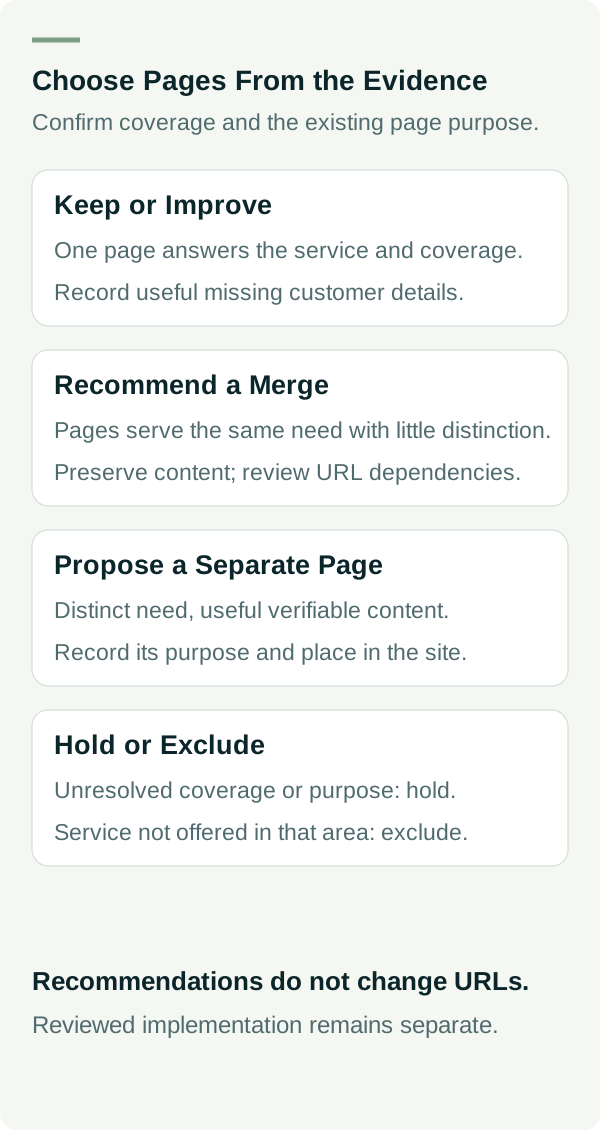
Choose Keep, Merge, Separate or Hold
| Recommendation | When it may suit the evidence | What to record before action |
|---|---|---|
| Keep / improve existing page | One page answers the service and genuine coverage clearly | Missing customer details and the proposed improvement |
| Merge recommendation | Pages serve the same need with little useful distinction | Preferred destination, content to preserve and URL/dependency review |
| Separate page proposal | A different need has useful, verifiable content and a clear place in the site | Purpose, evidence owner, intended page and navigation |
| Hold | Coverage, purpose or supporting evidence is unresolved | Exact missing fact and who can confirm it |
| Exclude from coverage plan | The service is not offered in that area | Owner confirmation and any existing misleading wording to review |
“Merge” in the sheet is a recommendation for a website review. The appropriate outcome might be combining content, improving hierarchy or another scoped change. Redirects and removals require their own reviewed implementation; do not apply them from a spreadsheet label alone.
An Example Coverage Decision
Imagine an example bathroom renovation business with three anonymised areas. Area A, B and C are teaching labels, not actual places or claims about any business's operations.
| Candidate | Owner-confirmed example facts | Decision | Reason |
|---|---|---|---|
| Area A and Area B suburb pages | Same offered service, process and booking arrangements; existing main page can explain both | Recommend combining useful coverage information on the main service/coverage page, subject to URL review | No distinct customer task has been established for two extra pages |
| A distinct service for a particular property type | Business genuinely offers it; scope differs and records support the explanation | Consider a separate service page with truthful coverage | The different service need, rather than a suburb label, gives the page a purpose |
| Area C page | Owner has not confirmed current coverage | Hold | A desired location is not evidence of an available service |
| Existing page for excluded work | Business confirms it no longer offers that work there | Review inaccurate coverage wording and dependencies | Correct the claim; decide URL treatment through a separate website review |
The worked example decision CSV records these proposed decisions. It contains no live URL changes, locations or measured search outcomes.
Build a Clear Route Through the Site
Use a service page to explain the work and a coverage page or section to explain where it is available. Add distinct area pages only when they help a reader and belong in a sensible hierarchy.
Navigation and contextual links should make the relationship clear. A person arriving at a location page should be able to understand the offered work, relevant conditions and enquiry route without a series of empty intermediate pages.
Use the same verified facts across the site and relevant profiles, while adapting the wording to each page's task. Consistency of facts does not require identical paragraphs everywhere. Our local business checklist helps review services, coverage and public information together.
Review a Proposed Merge Before Changing URLs
Use the architecture handoff checklist to identify incoming links, navigation, forms, downloads and any current performance evidence for affected pages. Decide what useful content must survive and which destination best serves the visitor.
Ask the website owner to prepare the exact change and rollback. A canonical tag is not a substitute for deciding what users should see, and this guide does not prescribe a particular technical fix for an unseen site.
After an implemented change, check the live destinations, navigation and enquiry path. Search discovery and business outcomes need later evidence; a successful page change does not prove better rankings or more suitable enquiries.
For help reviewing how service pages explain your genuine coverage, see our local SEO services.
If you want help reviewing a proposed suburb-page plan, talk to Matt. Bring the current page list, real service boundaries and the evidence that would make each proposed page useful.