

If a staging or test copy of your website appears in Google, ask your website provider to confirm the exact address and whether it should remain publicly accessible. Agree the lasting treatment for that copy, then discuss whether a temporary Google removal is appropriate. Removing a search result and restricting access to a website are separate jobs.
A staging site is a working copy used to review changes before they reach the public website. The useful outcome is a test environment with the intended access, a separately checked search status and a live website that still serves customers. A screenshot showing no search result establishes only part of that outcome.
Confirm Which Website the Result Opens
Copy the address from the result and record the observation date. Ask the provider to compare it with the live website and identify whether it is a staging copy, an old public page or something else. A similar design or page title does not establish which environment you are viewing.
Write down the test address and live address separately. Include a sample inner page on each. Where the test copy sits inside a folder on the live domain, have the provider identify the exact boundary before changing access or submitting a removal request.
Keep account details and private page content out of an ordinary enquiry. The provider can arrange an appropriate way to inspect anything sensitive. If the copy contains material intended only for authorised people, address its exposure with the responsible website owner rather than waiting for a search result to disappear.
For a broader investigation, our blocked, crawled or unindexed guide explains why current access and Google's recorded information can differ.
Decide What Should Happen to the Test Copy
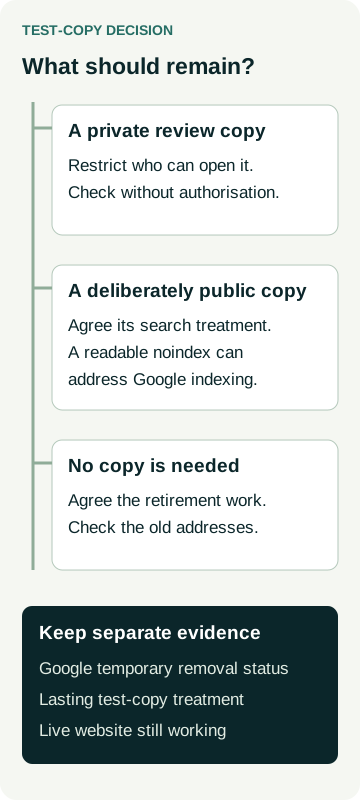
Ask whether the team still needs the copy. A private review environment, a deliberately public demonstration and a retired test site need different treatment.
Google's content-control guidance distinguishes password protection from a search indexing rule. Password protection restricts access to authorised users. A noindex instruction tells supporting search engines to exclude a resource from results; it leaves the content accessible to people who can open its address.
If the team proposes noindex, ask it to explain why public access remains appropriate. Google's noindex documentation says the crawler must be able to fetch the resource and read that instruction. A robots.txt block can prevent this. Do not ask the provider to expose private material so Google can read a tag; agree the access requirement first.
If the copy is no longer needed, ask the provider to explain its retirement treatment and demonstrate what the old addresses now return. Google's removal guidance covers removing content from a site as well as other lasting approaches. A deletion instruction alone does not show what a browser receives afterwards.
Agree two outcomes explicitly: who can open the test copy, and what should happen to its Google search results. Then check the live website separately.
Treat a Temporary Removal as a Separate Search Action
Google's Search Console Removals guidance says the tool temporarily hides results for about six months. It does not remove the underlying content from the internet or restrict access to it. A lasting treatment is still needed.
Before authorising a request, have the provider show the property, exact address and proposed scope. A single-URL request and a prefix request can cover different sets of pages. Ask which test pages are included and how the chosen scope avoids the live website. Do not approve a broad request merely because the provider calls it a staging cleanup.
Ask to see the request status after submission. A submitted or processing request is different from a confirmed temporary removal. The provider should also record what lasting change has been made, with a later check rather than a promise that everything will disappear by a particular hour.
If Search Console access is needed, use our provider access guide to discuss the property, recipient, role and action. This article does not authorise an account change or a removal request.
A Worked Example: Three Different Completion States
An example building business has a public website and a separate test copy for a redesign. A test service page appears in a Google result. The team agrees that only authorised reviewers should open the copy.
The owner asks for the same three checks at each handover: what an unauthorised visitor receives at the test address, what Google removal status has been recorded, and whether the live service page still opens normally. These example states illustrate the distinction; they are not observations from a customer website.
| Example state | What the evidence establishes | What remains to check |
|---|---|---|
| The result is temporarily hidden, but the test page still opens publicly | Search visibility has changed for the recorded request scope. | The agreed private access requirement remains unresolved. |
| The test copy requires authentication, while the removal request is processing | The tested address restricts unauthorised access; the request is not yet confirmed. | Record the later request outcome and remaining affected addresses. |
| Test access and temporary removal are confirmed, and the live page opens normally | The three recorded checks support their specific outcomes at that time. | Retain the lasting treatment and repeat relevant checks after the next copy or launch. |
The first state is incomplete even though a search screenshot looks reassuring. The second can represent useful progress while Google processing remains pending. The third gives the owner a clearer record, with the scope and dates still attached.
Keep Test Restrictions Separate From the Live Website
Ask how the team prevents test settings from being copied into production during a launch or later refresh. Before and after that change, have it check the intended public pages and enquiry route alongside the test environment. Review the SEO migration plan if a rebuild is underway.
Keep implementation evidence and search observations as separate entries. A current access check can pass while an older search record remains visible. A temporary removal can succeed while the underlying copy remains public. Neither observation alone establishes that the whole job is finished.
When discussing AWE's SEO services, contact us with the public website address and a brief description of the test-copy issue. Ask how assessment, website implementation and follow-up search checks would be scoped for your situation.