

Where readers would expect to know who produced your advice, identify the actual author and explain any meaningful review. Use accurate names, roles and relevant background. A short, truthful explanation is more useful than an impressive biography that the business cannot substantiate.
For an Australian service business, this can be a straightforward publishing task. Establish who contributed to an article, agree how those contributions should be described and connect the byline to useful background information. Keep authorship, review and publication responsibility distinct so customers can understand what each person did.
A review label should describe work that happened. Name the reviewer only after they have checked the agreed material, and avoid implying a broader endorsement than they gave.
Identify the People Behind the Content
Start with a private contribution record for the page. Who supplied the business information? Who drafted the explanation? Who checked the technical facts or the description of your process? Who approved publication? One person may perform several tasks, but the tasks should still be understood.
Google's people-first content guidance encourages accurate authorship information, including bylines where readers might expect them. It also asks whether a byline leads to further information about the author and the areas they write about. This supports a clear publishing practice; it does not establish a guaranteed ranking benefit from adding a name.
Agree the public attribution with the people involved. A writer who organised supplied information and a team member who checked one section have different contributions. Do not automatically label everyone an author, or turn permission to publish into a claim that someone checked every statement.
The appropriate presentation depends on the content and the way the business produces it. Some material may be attributed to an organisation. An individual article may suit a named writer and a separately described reviewer. Choose a truthful account of the work rather than inventing a person because a template has a space for one.
Write Background That Helps the Reader Judge Relevance
A useful author biography explains the person's connection to the subject. That might be their current role, relevant work they perform and the topics they contribute to. Select details that help readers understand why this person can explain this particular process or service.
Keep the wording specific. “Coordinates renovation enquiries and explains the consultation process” gives a different account from “construction expert”. Use the actual role and responsibilities. If qualifications, memberships or years of experience are included, verify those claims before publishing them.
Google's guidance warns against deceptive authorship information, including fabricated profiles and false credentials. Do not use a generated portrait or stock headshot to imply that an invented expert works for the business. If you have no approved portrait, a clear text biography can still identify the real contributor.
Avoid making every biography a sales pitch. A person can have relevant practical knowledge without claiming to be the leading authority on an entire industry. Keep unrelated hobbies or achievements only if they serve the intended page and the contributor wants them published.
Use information approved for public use. A work role and relevant background may be useful; private phone numbers, personal addresses and unrelated employment records generally do not belong in the article's author box. Keep supporting verification records in the appropriate internal location.
Describe What the Reviewer Actually Checked
Define the review before adding a public label. Did the reviewer check a service description, the current enquiry process, technical terminology or the complete article? Give them the relevant version and enough context to decide whether the statements are accurate.
Record the scope and any exclusions internally. A project manager might check how a consultation proceeds without reviewing a statement about pricing. If a price or service claim remains unresolved, correct it or hold it for the appropriate person rather than allowing a general review label to cover the gap.
Public wording should be proportionate to that contribution. “Consultation steps checked by the project manager” communicates a narrower task than “Expert reviewed”. Use a label that matches the work and helps the reader, rather than one chosen mainly to sound authoritative.
Keep editorial approval separate too. Someone may approve tone and publication while another person checks the practical details. Both can matter, but neither should be silently substituted for the other. Our guide to buying SEO content covers the broader research, drafting, corrections and approval process.
If the review leads to changes, return the relevant revised passages to the reviewer before claiming those passages were checked. A review of an earlier draft does not automatically apply to a later rewrite with new claims.
Give the Editor an Attribution Record
The record below helps the business and editor agree what to publish. It is a planning tool, not evidence that any named person has contributed to a particular website.
| Part of the Record | What to Confirm | Public Presentation |
|---|---|---|
| Author | Who created the content and the attribution they agree to | Accurate byline or organisation attribution |
| Background | Relevant role and verified claims approved for publication | Short biography with useful context |
| Review | Reviewer, version, material checked and unresolved points | A label matching the completed review scope |
| Ownership | Who maintains the article and contributor information | A reliable route to current background information |
Include the intended destination for each author link. It might be an individual contributor page or a suitable part of the business's About page. Check that the destination identifies the right person or organisation and provides the background promised by the link.
Do not create a large collection of nearly empty profile pages merely to fill a template. First decide what useful information is available and how it will be maintained. A small business needs a workable record, rather than biographies nobody owns after launch.
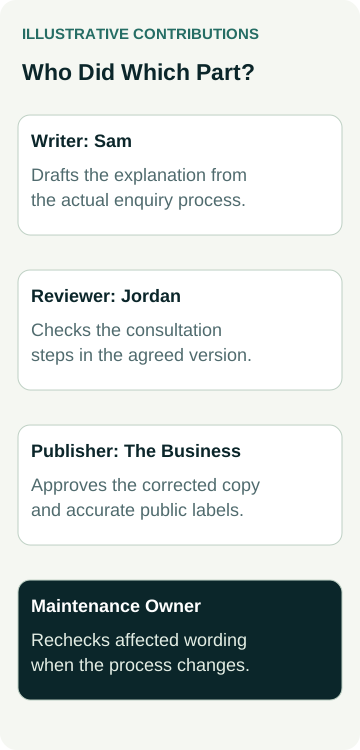
A Worked Example: Explaining a Renovation Consultation
Illustrative example only: Sam and Jordan are example contributors, not AWE staff or a real client team.
A renovation business prepares an article explaining what happens during its initial consultation. Sam, who coordinates enquiries, drafts the explanation using the business's current process. Jordan, the project manager, checks the described consultation steps and identifies one outdated instruction.
The editor corrects that instruction and returns the changed passage to Jordan. The business records which version was checked. Sam's public background describes the enquiry-coordination role, while the review note explains that Jordan checked the consultation steps. It does not claim that Jordan assessed every possible renovation issue.
The article makes no invented qualification, licence or long-term experience claim about either person. If the business wants to include a credential, it must first verify the actual fact and agree its wording. The names and roles in this example are not copy to transfer to your own website.
The owner also appoints someone to revisit the page when the consultation process changes. A later change to how enquiries are handled should trigger a check of the affected explanation and any review note. The original contribution remains part of the history; it does not prove that the current process is unchanged.
This example ends with accurate attribution and a defined review record. It does not demonstrate a search ranking, an AI citation or an additional renovation enquiry.
Keep Visible Information and Technical Details Consistent
Have the website editor check the published byline, biography links and review wording together. Follow each link on the actual page and confirm it leads to the intended background. A contributor's name in a drafting document does not establish what a visitor can see.
If the site uses Article structured data, Google's Article documentation gives author-markup guidance for people and organisations. It recommends identifying authors clearly and using appropriate identity links. The technical owner should make the implementation reflect the actual authorship presentation rather than adding an unrelated expert name.
Do not treat a reviewer as an author merely because the site's template only has an author field. Explain the real contribution to the developer and agree an accurate implementation. Use the separate schema-markup scope guide if structured-data work is being proposed.
Technical validation, correct visible attribution and later search appearance are different checks. A passed code test does not verify a person's background or guarantee a particular search feature. Keep the business facts and technical implementation under their respective owners.
Maintain the Attribution When the Content Changes
Keep the contribution record with the article's working materials. When a role, biography or article changes, identify which public statements and links need review. A contributor leaving the business does not make their historical authorship untrue, but a biography describing them as a current employee may need correction.
Use publication and update dates to describe what actually happened. Do not refresh a date merely to suggest that unchanged advice has been newly checked. If an article receives new material, agree who will verify that material and how any review note should change.
When discussing SEO support for your business, bring a representative article and its real contribution record. Agree the writing, review, publishing and maintenance work included in the scope. Accurate attribution helps readers assess the explanation; search visibility, suitable enquiries, accepted jobs and revenue still require separate evidence.