

Before paying for business listing cleanup, ask for the actual records, the incorrect details and the proposed correction for each one. A report showing a large number of inconsistencies is a starting point for investigation. It does not show that every item needs changing or that a supplier can correct every publisher's record.
SEO providers often call online mentions of a business's identifying details local citations. A cleanup proposal might cover directory entries, map listings, industry profiles or information distributed through another service. Ask which records are included, rather than treat “citations” as one uniform product.
For a small Australian business, the practical aim is clear customer information. People should reach the right website, use the current contact details and understand the actual service or visiting arrangements. Keep those outcomes separate from promises about rankings, listing counts or new enquiries.
Look at the Public Record Behind the Warning
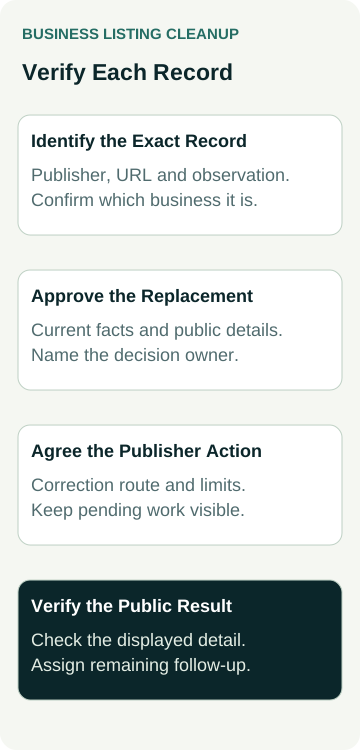
Start with a few specific examples from the provider's report. Ask for the publisher, the public page address, the observation date and the detail said to be wrong. Open the record and compare what customers see with what the report describes.
An old telephone number needs a different response from a shortened street name that still identifies the correct place. Another record may describe a former branch, a separate business or an industry membership. Check that relationship before approving a bulk change or removal.
Keep the exact observation in the working record. “This directory page shows our previous telephone number” is useful. “Our business information is wrong everywhere” is too broad to define the work or verify the result.
Our Australian business directory guide covers choosing relevant platforms. Cleanup starts with the records already found. A list of places where a business could be added is a different deliverable from evidence that existing information needs correction.
Approve the Current Business Facts First
Prepare an owner-approved reference for the information that may be published. Include the trading name, current contact number, website destination, offered services and relevant customer arrangements. Add an approval date and identify who will resolve uncertain details.
Decide whether an address is meant to be public and whether customers can visit it. Do not give a supplier an administrative or home address to distribute simply because a template has an address field. Ask how the proposed listing fits the real business and that publisher's requirements. If it does not fit, hold the submission and discuss an appropriate alternative.
Separate approved facts from the way a publisher formats them. A platform may display a category or address differently from your website. Ask whether the difference changes the meaning or sends customers to the wrong place before treating typography alone as an urgent repair.
Google explains that its business information can come from several sources, including public web content, licensed data and user contributions. That is a reason to review information carefully. It does not prove that a particular directory supplied an error or that one correction will immediately update every other platform.
Turn the Quote Into a Record-by-Record Plan
Ask the provider to identify the proposed action and the route available for each priority record. It might update a listing through authorised access, request a publisher correction or investigate an apparent duplicate. Those actions involve different dependencies and levels of control.
Use a short planning record:
| Record Found | Question Before Action | Decision to Agree |
|---|---|---|
| Current business with an outdated contact detail | Which owner-approved fact should replace it? | Exact correction and how the public result will be checked |
| Two similar records on one publisher | Do they represent the same business and circumstances? | Investigate before proposing a merge, removal or update |
| Listing without established management access | What correction or access route does the publisher provide? | Responsible person, required approval and known limits |
| Unclear, unavailable or unsuitable record | What evidence or publisher response is missing? | Hold or exclude with a reason and a next review |
Do not use the same cleanup procedure for every platform. Our duplicate Google Business Profile guide addresses that particular product and its business relationships. A rule for Google profiles is not automatically a rule for a directory or association's member page.
Agree who may request changes before sharing access or starting the work. A paid assessment does not, by itself, authorise every ownership request, deletion, new subscription or public edit that a supplier might later recommend.
Keep Submitted and Verified Corrections Separate
Ask how the supplier will report each stage. A request sent to a publisher, a change saved in a dashboard and a correction visible on the public page are different observations. Keep their dates and evidence separate.
For a completed correction, request the exact public address and the relevant detail now displayed. Check that a website link reaches the intended destination, rather than assume a changed label also changed the link. Confirm the result without placing calls or sending enquiries merely to test contact details.
If a publisher is reviewing the request or cannot be reached, keep the item pending or blocked with the reason. Agree what follow-up is included and who handles anything still unresolved. Do not let a summary count silently turn attempted corrections into verified results.
A useful cleanup report lets you trace each approved change from the original observation to the current public record.
Ask whether the work is a one-off correction or depends on a continuing distribution service. Have the supplier explain what happens to the records and access if that service ends. Record the actual arrangement rather than assume every update will remain in place indefinitely.
A Worked Example: An Old Contact Number
An example commercial-cleaning business changes its enquiry number while continuing to provide the same services. A supplier finds the old number on a directory entry and an association member page. It also flags another similarly named company.
The owner approves the new public number and the intended website destination. The similarly named company is excluded from the correction request after the owner confirms it is a separate business. Matching words in a report do not make it a duplicate of this business.
The directory change is requested through its stated correction process. The association page needs a separate request to its administrator. The proposed handover keeps both requests identifiable and records when a public check can be made.
If one page is corrected and the other remains under review, the report should show those different states. The business has not completed both changes simply because two requests were sent. This example describes a proposed scope and reporting method only. No listing has been edited, administrator contacted or change in calls or rankings measured here.
Agree Access, Fees and Future Responsibilities
Ask which records the business already controls and which require investigation. Clarify what access is necessary, who approves it and how the business retains the working record. Keep passwords and recovery information out of public reports and routine briefing documents.
Have the quote distinguish the initial assessment, attempted corrections, new listings and ongoing monitoring. Publisher fees or a paid listing upgrade should be identified separately before the business commits. An accuracy problem does not automatically justify buying advertising on that platform.
Ask how future changes will be managed. A new number, changed service or relocation may affect records beyond the ones corrected today. Keep the approved information and the list of known publishers so the next person can understand what was done and what remains uncertain.
For unresolved items, record the owner and next action. “Awaiting publisher review” is a useful status when it is accurate; a green completion badge with no public evidence is less useful to the business.
Review the Result Without Assuming an SEO Gain
At handover, review a selection of priority corrections and any remaining exceptions. Check whether customers now see the approved information, the requested actions stayed within scope and the business knows how to maintain the records.
Google's local-ranking guidance encourages complete and accurate Business Profile information and says there is no way to request or pay for a better local ranking. That guidance does not establish a ranking gain from a quoted number of directory corrections.
Keep visibility, website visits, suitable enquiries and paid jobs as separate measures. A correct public record is a result you can verify. Whether it produced a useful customer or improved search performance needs its own evidence and review period.
To discuss this work within a campaign, review AWE's local SEO services with the actual listing addresses and approved business details. Agree the publishers, correction attempts, public checks and ongoing responsibilities in the scope before work starts.