

Before paying for a Google review-request service, ask to see the complete customer journey. Agree who will receive an invitation, what it will say, where every button goes and who will deal with the responses. A promise of more reviews tells you little about how the service will represent your business.
For an Australian trade or service business, the useful purchase is a manageable way to invite honest feedback from genuine customers. Keep the customer's rating and wording their own. Your supplier should be able to explain the proposed process without promising favourable reviews, a particular star rating or a Google ranking.
Start With the Customer Group and Trigger
Write down the real customer event that would make someone eligible for an invitation. That might be a completed maintenance visit or a delivered order. Choose an event your business can identify consistently, then ask the supplier how its system will recognise it.
Keep the rule independent of whether someone seemed pleased. Google's Maps contribution policy prohibits selectively asking customers for positive reviews and discouraging negative ones. A list assembled from compliments alone needs a different approach before it becomes a review-request campaign.
Explain awkward cases during the proposal discussion. A booking cancelled before any service, a repeated visit for the same job and an incorrect contact record are different problems. Ask how the supplier would handle each, and record the reason for an exclusion. Do not quietly exclude a genuine customer because you expect criticism.
The business should own the customer definition and the decision to contact people. Agree what customer information a supplier would need, who would have access and how the proposed messages will be authorised. Those decisions belong before any upload or connection to your booking or invoicing software. A review-link demonstration alone does not settle data handling or permission to send messages.
Read the Invitation and Every Route After It
Ask for the exact proposed wording, including reminders and the message preview customers will see. It should invite an honest account of a real experience. Remove requests for a particular rating, praise for a named employee or prescribed phrases about your service.
Google's review-request guidance explains that businesses can share a review link or QR code. It also says reviews must reflect genuine experiences and prohibits incentives for posting, changing or removing reviews. Paying a provider to administer invitations does not mean buying customer endorsements.
Then follow the proposed journey with sample records. If an opening survey asks for a satisfaction score, inspect what a lower score and a higher score would each see. Sending only the favourable group towards a public review while directing everyone else away is a reason to revise the setup. This filtering is often called review gating.
Customers can still have a separate way to raise a service concern. Keep that route available without making a favourable answer the price of seeing the review invitation. Ask the supplier to show both routes clearly, rather than relying on a claim that its software is compliant.
Check the whole journey before approving it. A neutral opening sentence can still lead into a process that filters customers by sentiment.
Turn the Proposal Into a Checkable Scope
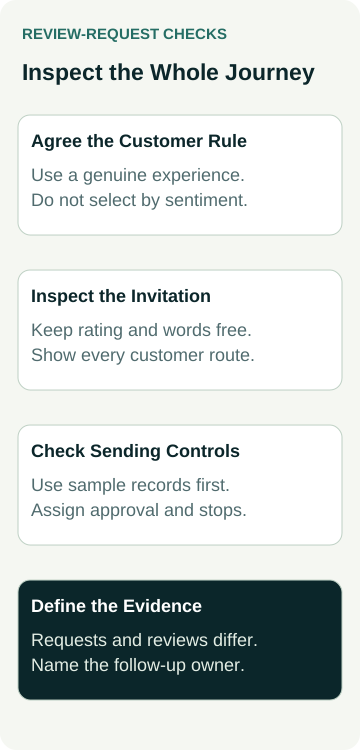
Use a short record to compare suppliers. The record below is a practical buying aid; it is not a certification of a particular platform or a substitute for checking your business's messaging obligations.
| Check | Evidence to Request | Decision to Record |
|---|---|---|
| Customer rule | A real completion event and sample eligible and excluded records | Who owns the rule and why any record is excluded |
| Message and routes | Invitation, reminders and every destination shown with sample responses | Approved neutral wording and no sentiment filter |
| Sending controls | Proposed timing, repeat handling and stop or suppression behaviour | Who approves contact and how a request can be stopped |
| Reporting and support | Example report, issue process and scope of continued access | What was sent, what was observed and who follows up |
Request a demonstration using invented sample records before sharing customer information. Ask the supplier to show a duplicate job record, an uncontactable address and someone who should no longer receive messages. You are checking how the proposed system behaves, not asking it to send a trial campaign to real customers.
Also ask what the quote includes. Compare these items separately:
- Setup and approval of the customer rule, invitation and routes.
- Software charges, message allowances and any ongoing monitoring.
- Changes, issue handling and access to your records if you leave.
Confirm which work continues after setup. Do not assume a monthly software fee includes someone reviewing every customer issue.
A Worked Example: Requests After Garden Maintenance
An example garden-maintenance business wants less manual work after completed visits. Its owner receives a proposal to connect job records to a review-request tool. The first draft describes sending invitations to customers marked as happy in the job notes.
The owner asks for the customer rule to be revised around genuine completed work, without using the expected rating to select people. The supplier must explain repeat visits and duplicate records, and show the proposed invitation with sample information. The owner also needs to settle whether and how customers may be contacted before turning on a sending connection.
During the demonstration, one sample customer indicates a problem with the visit. The owner checks that this response does not hide the public review route. A separate contact option lets the customer raise the concern with the business. Neither route offers a discount, asks for a five-star rating or supplies words for the customer to post.
The owner records three unresolved items: the repeat-request rule, the exact reminder wording and who receives service concerns. Approval waits for those answers. This is a buying example, with no actual customer campaign, platform test, policy certification or result implied.
Keep Invitations, Reviews and Business Results Separate
A report should distinguish an invitation prepared, a message sent, a reported delivery and a review observed on the profile. Ask what each label means and where its evidence comes from. A sent message is not proof that a customer saw it or that a review was published.
Avoid treating a review as a confirmed response to a particular invitation unless there is adequate evidence for that connection. An existing customer may leave feedback independently. Some people will choose not to review at all. Record what the tool can observe and leave the rest unknown rather than presenting an assumed conversion rate as a measured one.
Agree who checks the live profile and who deals with questions about missing, changed or disputed reviews. The supplier can describe the work it will perform; it cannot promise that a particular review will stay visible. A buying decision should not depend on a guaranteed number of favourable reviews or a guaranteed position in search.
For the business, enquiries and accepted jobs are further outcomes to track separately. Review-request activity alone does not show that a new customer found you, chose you or paid for a service. Review the process for customer experience and manageable administration as well as whatever visibility evidence is available.
Assign the Ongoing Work Before Switching It On
Decide who approves changes to invitation wording and customer rules. Name someone to receive service concerns, someone to check unexpected sending behaviour and someone authorised to pause the process. An unattended notification inbox can leave a promised follow-up without an owner.
Keep public replies human-reviewed where the situation needs judgement. A business can acknowledge a concern without publishing job details or private correspondence. Google's guidance recommends protecting the reviewer's privacy and keeping replies helpful. Agree how a sensitive complaint reaches the right person instead of assuming an automatic response settles it.
If you later want to use a customer's words on your website, treat that as a separate decision. Our guide to testimonial quotes, permission and context explains the material your designer needs. Collecting a Google review does not by itself establish the approved wording, attribution, photograph and context for a website card.
Bring a Clear Review Process Into the Local SEO Discussion
Ask a prospective supplier for the customer rule, complete message journey, sending controls and example report in writing. Mark anything it has not demonstrated. That gives you a useful basis for approving a bounded setup, requesting changes or keeping the process manual while questions remain.
If review requests are one part of a wider local-search proposal, compare them with the other work your business needs. Our local SEO services cover business information, local service pages, trust signals and measurement. Bring the proposed review workflow to that discussion so its scope, owners and checks can be agreed around your actual business.