

Before approving redirect-chain repairs, ask for the original address, every intermediate step and the final page. Confirm that the proposed destination still answers the customer's original need. A shorter route to the wrong service page is not a useful repair.
A redirect chain sends a request through one redirect and then another before it reaches a destination. It can develop as a website changes addresses over time. A customer may still arrive at a working page, so the issue can be less obvious than a broken link.
For an Australian business owner, the useful deliverable is an agreed URL map, a bounded change and checks of the affected routes. Ask the provider to separate the reason for each change from a tool's warning count. This guide helps you review that work without asking you to edit hosting or server rules yourself.
Keep the old starting address in the review. Opening only the final page cannot show whether the reported route has been repaired.
Ask for the Complete Route
Request the exact starting URL and the report date. Include the link's source where known: a current menu, an old brochure, a referral or a historical page list. Ask the reviewer to record the current response sequence separately from an earlier crawl's finding.
For each step, request the address, response and next destination. Include the final page's content and any error. The provider should distinguish a sequence that reaches a page from a loop that returns to an earlier point and fails to finish. MDN's HTTP redirection guide explains redirect responses and loops.
A screenshot of the final page is useful customer context, but it omits the intervening responses. Ask for both the technical sequence and a plain explanation of what someone following the original link encounters.
If the report instead starts with a missing address, use the 404 decision guide to assess what should exist there. Here, the task starts with a reported sequence of redirects, including routes that may already reach a useful page.
Confirm the Destination and Each Exception
Ask the business owner to approve the destination's purpose. Does it describe the same current service or information? Is the coverage accurate? Does its contact route invite the type of work the business accepts?
Google's site-move guidance recommends avoiding redirect chains and directing requests to the final destination. It also warns against irrelevant destinations. Apply those points to an agreed map; they do not establish that the last address in an existing chain is automatically suitable.
Ask why the intermediate steps exist. They might reflect old page moves, shared address rules or another system's routing. If the reviewer cannot explain a step, record that uncertainty before approving its removal. A general instruction to delete all redirects does not define a safe change.
Keep exceptions explicit. A campaign address with extra information after a question mark may need a different check from the plain page address. Ask what that information is used for and who owns the decision about keeping or changing it. Do not strip it merely because the shorter address looks cleaner.
Where the underlying service has ended, use the service-retirement guide to settle the continuing information need. A broad services page is not automatically a substitute for an unavailable specialist service.
Approve a Map and a Bounded Change
Ask the proposal to name the rules or website locations it will change, the addresses affected and the exceptions it will preserve. One rule can affect more than the example URL shown in an audit. Request the intended reach and representative checks before approving a broad pattern.
Use a record such as this one alongside the provider's technical export:
| Review Item | Record to Request | Approval Question |
|---|---|---|
| Original route | Starting address, dated sequence and final page | Is this the route the report identified? |
| Proposed destination | Exact address and current page purpose | Does it answer the original customer need? |
| Change and exceptions | Named rule or link, affected addresses and retained variations | Is the reach understood and authorised? |
| Completion checks | Original starts, current links and preserved routes | What evidence will show the agreed work was delivered? |
Google's redirect documentation distinguishes permanent and temporary moves. Permanent server-side redirects include 301 and 308 responses. Ask the implementer to choose the method matching the agreed change, rather than automatically replacing every temporary response.
An address preference can also involve duplicate-page decisions. Use the canonical URL guide if that is the underlying issue. A canonical preference and a redirect are different mechanisms; changing one does not document the behaviour of the other.
For a wider rebuild, put the map inside the SEO migration plan. A small chain repair should not quietly become authority for a domain move, deleted content or a new website structure.
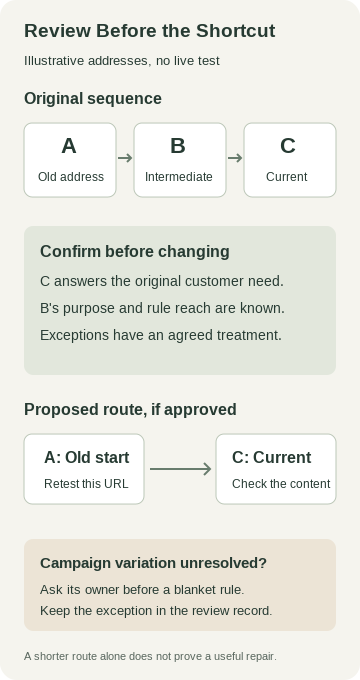
A Worked Example: A Repair Page and a Campaign Address
This is a hypothetical approval exercise, not an AWE client, actual redirect test or measured result.
Example Repairs has renamed its appliance-repair page twice. Its old brochure address redirects to an intermediate service address, which redirects again to the current repair page. The owner confirms that the current page describes the same work and has accurate enquiry instructions.
The provider proposes a direct mapping from the old brochure address to that current page. The scope also lists a current website link still using the intermediate address. The owner can review those two changes separately: support the old published address and update the link under the business's control.
Another campaign address contains an extra reference value. Nobody reviewing the proposal has yet confirmed whether a connected reporting process uses it. Its treatment remains unresolved. The owner asks the responsible person to explain that dependency instead of approving a blanket rule that removes every reference value.
The revised scope must either preserve that route or document an authorised decision and its checks. The example supplies no rule syntax or completed fix. It shows why a useful destination alone does not settle every variation included in a repair quote.
Verify the Starting Addresses and Current Links
After implementation, request a new trace beginning with each agreed old address. Compare it with the approved route and exceptions. Also inspect the final content and the customer next step. A response sequence and a suitable service explanation answer different parts of the review.
Follow the current internal links that were meant to change. A repaired old redirect and an updated menu link are separate deliverables. Where the business controls a link, the reviewer should confirm its actual published destination. External references remain separate dependencies; nobody should claim they were edited without checking them.
Ask how caching was accounted for and which address variations were checked. Have the technical owner explain failures or unexpected steps before marking the task complete. Keep calls, real enquiries and bookings within an agreed test scope; reaching a form does not establish message delivery.
Record the original finding, approved map, delivered changes, checks and remaining questions in the SEO change log. Preserve the earlier report rather than replacing it with an unexplained green status.
Keep Search and Business Outcomes Separate
A current route check can establish the tested behaviour. It does not show that Google has processed the change, that rankings rose or that the business received better enquiries. Review those outcomes using their own dated records and comparable periods, with other relevant changes disclosed.
If a later audit repeats the warning, compare its crawl date and exact starting address with the completion record before commissioning the same repair again. It may describe an older observation, a preserved exception or a new issue requiring investigation.
When discussing work with an Australian SEO agency, bring the report, starting URLs and intended customer destinations. Contact Australian Web Experts to agree the investigation, implementation, exceptions and verification scope before work begins.