

Before approving a content refresh, ask the provider to show what a reader will learn or understand better afterwards. The work might correct outdated advice, explain a missing part of the process or make an answer easier to use. A new date and a few reworded sentences do not establish that improvement.
Start with one existing page and a marked comparison. Identify the customer question, the information that is wrong or incomplete, and the proposed replacement. That gives you something concrete to assess before commissioning changes across an archive.
Separate Page Age From the Problem to Fix
An older guide can still answer a useful question accurately. A recently published page can already contain an incorrect service claim. Review the information itself rather than using the publication year as the decision.
Google's people-first content guidance cautions against changing dates without substantial content changes and against adding or removing content mainly to make a site seem fresh. It asks whether the page provides useful, reliable information for its audience.
Ask what triggered the proposed refresh. Was a business process changed? Does a source no longer support the advice? Are readers missing an explanation they need before enquiring? A fall in clicks deserves investigation, but it does not identify which sentence needs rewriting.
Keep the reporting period and page purpose visible. Low recorded traffic can prompt a review without settling whether a page still helps customers. If the concern is attracting the wrong searches, our query-mix guide covers that separate assessment.
Ask for Three Parts of the Refresh Proposal
Request the current passage, reason for changing it and proposed replacement. Read them together. “Optimise this article” is difficult to assess; “the preparation advice asks for documents customers do not need at first contact” names a problem the business can check.
For a factual correction, name the person or source that can confirm it. A writer can check public product documentation, but your business must confirm its own services, exclusions and enquiry process. Our SEO content buying guide explains how to supply and approve those inputs.
For a fuller answer, ask what useful explanation is being added. It might clarify when a customer needs a document, show an example they can recognise or explain an important limitation. Adding length without resolving the missing question leaves the proposal unfinished.
Check what must remain too. An edit that sounds smoother can accidentally remove a useful exclusion or preparation detail. Put those details beside the proposed wording before approval.
Compare the reader's next decision before and after the edit. Name the new help or corrected fact, then check that the necessary existing information survives.
A Worked Example: Three Versions of a Preparation Guide
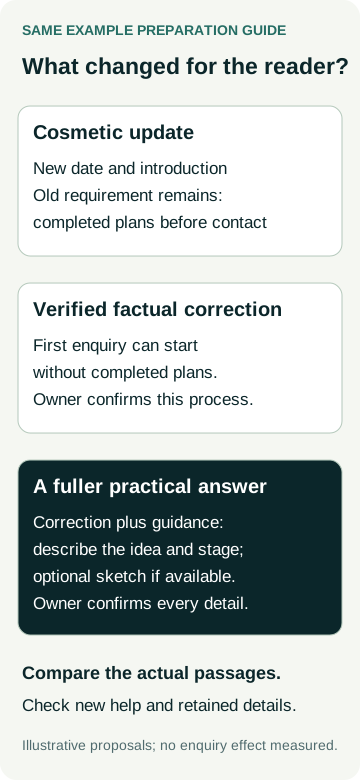
An example garden-design business has an older article about preparing for a first enquiry. Its current wording says customers need completed plans before contacting the team. For this example, the owner confirms that the business accepts early ideas and only asks for detailed documents later when the project needs them.
The provider presents three possible updates:
| Proposed version | What changes | What the owner can assess |
|---|---|---|
| New date and a rewritten introduction | The old requirement for completed plans remains. | The identified factual problem is still present. |
| Corrected preparation requirement | The article explains that completed plans are not required for the first enquiry. | The owner can confirm that the correction matches the actual process. |
| Corrected advice with practical preparation help | The page also explains how to describe the desired change, note the project stage and share an optional sketch if available. | A reader has clearer starting information without being asked to invent documents. |
The third version needs factual review as well. The provider cannot assume that sketches are accepted or optional merely because the wording sounds helpful. The owner must confirm every part of that proposed example process before it becomes public advice.
Ask to see the revised passage, not only this classification. In the example, a possible opening is: “You can contact us while you are exploring ideas. Describe what you would like changed and the stage you have reached.” Any further document instructions would follow the business's confirmed requirements.
This is an illustrative review exercise, not a description of AWE's services, a client result or evidence that one version increased enquiries. The useful distinction is between a cosmetic change, a verified correction and an expanded answer a reader can act on.
Recheck Sources and Dates Together
If a refreshed article includes technical advice or statistics, ask the writer to return to the relevant source. Check what the source establishes and whether it applies to the business, audience and period being described. An updated link or newer study does not automatically support the old sentence.
Where an article has genuinely changed, have the website person make the visible update information and corresponding page data consistent. Google's byline-date guidance distinguishes publication and update dates and recommends consistency between equivalent visible and structured values. It does not guarantee that Google will show the date supplied.
Keep the reason for an update in the internal record. A date can tell a reader when work occurred; the comparison explains what changed. Do not present an old event date as the page's new publication date.
Keep Removal and Merging as Separate Decisions
Sometimes a review shows that the page's purpose has ended or that useful information belongs elsewhere. That needs its own assessment. Google's core-update guidance, in the context of evaluating content after an update, treats deletion as a last resort when the content cannot be salvaged. It is not an instruction to delete an age-based quota.
If the proposed work combines overlapping pages, use the page-merge review to identify what must be preserved. If the business has stopped offering the service, the service-retirement guide covers the customer message and connected routes. A refresh brief should not silently approve either action.
Review the Delivered Page Before Its Results
At handover, compare the approved replacement with the public page. Check the corrected advice, retained details, source links and customer next step, including on a phone. Record any unfinished item with the person responsible for it.
Use the SEO change log to distinguish the verified content change from its later measured effect. Search visibility, useful enquiries and won work need their own evidence. A revised article or a newer date does not establish those outcomes.
When discussing AWE's SEO services, bring us one existing page and the proposed refresh. Ask how factual review, useful additions, publication checks and later reporting would be scoped before agreeing to a batch of updates.